


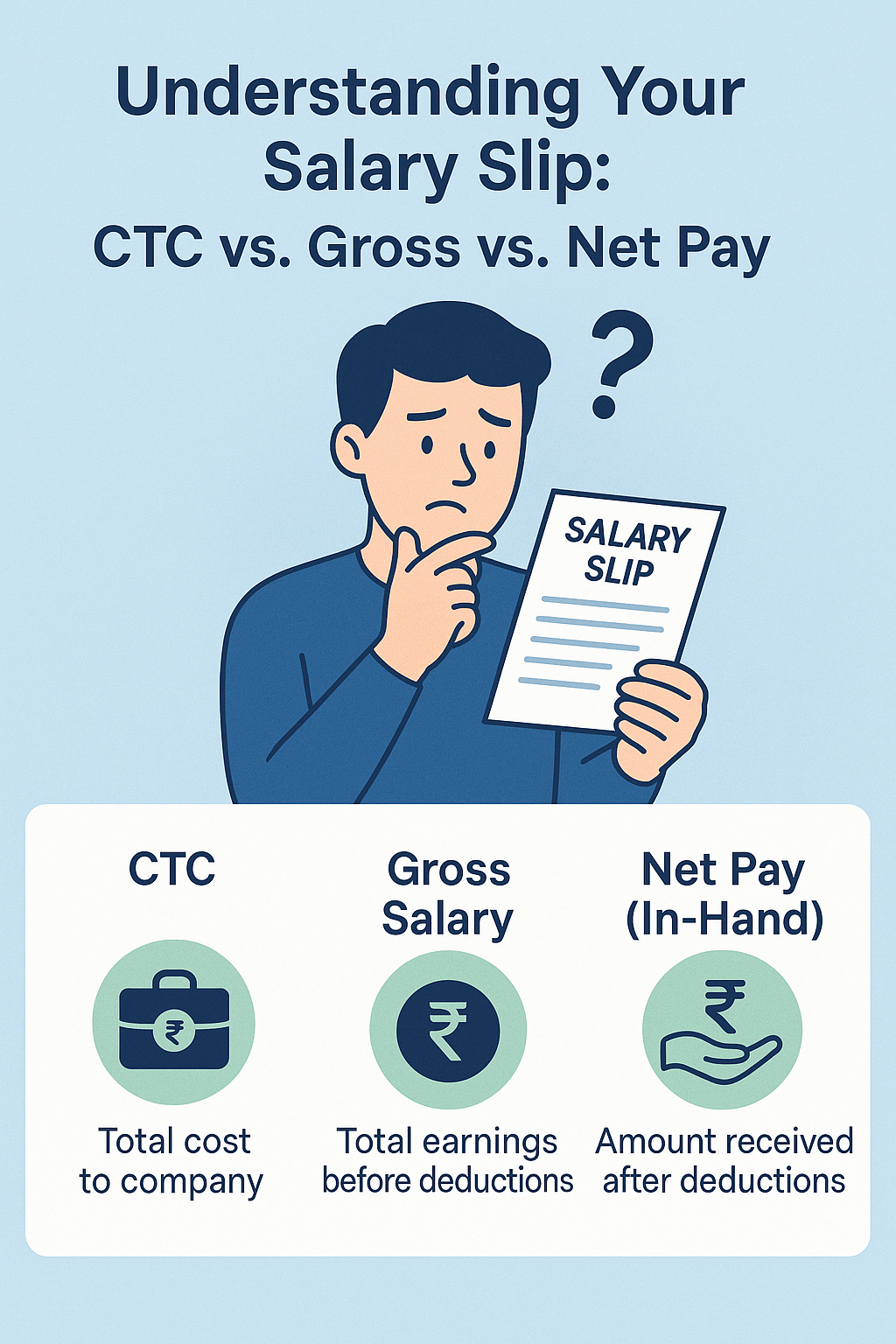
Understanding Your Salary Slip: CTC vs. Gross vs. Net Pay (A Simple Guide)
It is a rite of passage for almost every Indian fresher. You negotiate a job offer for a CTC (Cost to Company) of ₹6 Lakhs per annum. You pull out your calculator, divide by 12, and excitedly expect ₹50,000 to hit your bank account at the end of the first month.
Then payday arrives. You check your balance, and instead of ₹50,000, you see ₹38,000.
Panic sets in. Did they make a mistake? Did you get a pay cut without knowing? Is this a scam? The answer is usually no. Welcome to the complex world of the Indian Salary Structure. The gap between what a company "pays" for you (CTC) and what you actually get to spend (Net Salary) is filled with various components, deductions, and statutory contributions.
For many professionals, a salary slip looks like a confusing receipt written in a foreign language. Terms like "Basic," "HRA," "Provident Fund," and "Special Allowance" are tossed around, but rarely explained. This lack of financial literacy puts you at a disadvantage during salary negotiations, as you might bargain for a high CTC without realizing it translates to a low in-hand amount.
This guide is your decoder. We will break down the jargon, explain the math behind the deductions, and help you understand exactly where your money goes—and how to negotiate a structure that maximizes your take-home pay.
The Three Layers of Your Salary
Think of your salary like an onion. You have to peel back layers to get to the core.
Layer 1: CTC (Cost to Company) – The Total Spend
Definition: This is the total amount the company spends on you in a year. It is the number usually mentioned in your offer letter. What it includes: * Your take-home salary. * Retirement contributions (PF). * Bonuses and incentives. * Insurance premiums paid by the company. * Sometimes, even the cost of the coffee you drink or the laptop you use (in some rigid structures). Reality Check: You will never see this entire amount in your bank account. It is an expense figure for the company, not an income figure for you.
Layer 2: Gross Salary – The "Paper" Salary
Definition: This is your salary before taxes and statutory deductions are removed, but after removing employer contributions (like the employer's share of PF and Gratuity). What it includes: * Basic Salary * House Rent Allowance (HRA) * Leave Travel Allowance (LTA) * Special Allowances Reality Check: This is the number that appears at the top of your salary slip, but it is still not what you take home.
Layer 3: Net Salary (In-Hand) – The Real Money
Definition: This is Gross Salary minus Deductions. This is the actual cash credited to your bank account.
The Formula: Net Salary = Gross Salary - (Income Tax + Employee PF + Professional Tax)
Decoding the Components: Where Does the Money Go?
Let's look at the specific line items that eat into your CTC.
1. Basic Salary
This is the core component, typically 40-50% of your CTC. It is fully taxable. Why does it matter? Because your PF and Gratuity are calculated as a percentage of this Basic amount. A higher Basic means higher retirement savings but potentially lower immediate take-home pay.
2. HRA (House Rent Allowance)
This is typically 40-50% of your Basic Salary. It is provided to meet your accommodation costs. * Tax Benefit: You can claim a tax exemption on HRA if you actually live in rented accommodation and have valid rent receipts. If you live with your parents or own a home, this becomes fully taxable.
3. PF (Provident Fund) – The Forced Savings
This is the biggest chunk that "disappears." * The Rule: 12% of your (Basic + DA) is deducted from your salary (Employee Share). * The Match: The employer also contributes 12% (Employer Share). * The Twist: In many companies, both the Employee and Employer contributions are part of your CTC. So, 24% of your Basic Salary is locked away for your retirement. You get it back with interest when you retire or leave the job, but you can't spend it now.
4. Professional Tax (PT)
This is a state-level tax levied on salaried employees (in states like Maharashtra, Karnataka, Tamil Nadu, etc.). It is a small but mandatory deduction, usually around ₹200 per month.
5. TDS (Tax Deducted at Source)
This is your income tax. The employer estimates your annual tax liability based on your salary and investments, divides it by 12, and deducts it monthly to pay the government on your behalf.
How to Use This Knowledge in Negotiation
Now that you understand the breakdown, use it to your advantage.
- Don't Just Negotiate CTC: When you get an offer, ask HR: "Can you provide a rough estimate of the monthly in-hand salary?"
- Optimize Your Allowances: Some companies offer a "Flexible Benefit Plan" (FBP). You can choose components like Food Coupons (Sodexo), Internet Allowance, or Vehicle Lease options. These are often tax-free or tax-efficient, meaning choosing them can reduce your tax burden and increase your effective purchasing power compared to taking it all as taxable "Special Allowance."
- Understand the PF Impact: If you are young and need cash flow, a high Basic salary forces high PF contributions (low take-home). If you want to save tax, a high Basic is good. Understand what you need.
Conclusion: It's Not What You Make, It's What You Keep
Your salary slip is a financial report card. Learning to read it is the first step toward financial literacy. Don't be afraid to ask your finance or HR team to explain specific deductions.
Remember, a ₹10 Lakh CTC offer with a high variable component and low tax efficiency might result in the same monthly bank transfer as an ₹8.5 Lakh CTC offer with a tax-optimized structure. Always do the math.
To find jobs that offer competitive packages (and hopefully transparent breakdowns), keep searching on JobPe and set up your job alerts for roles that match your financial goals.
For more tools to help you navigate your career and your compensation, https://jobpe.com.

Creative Content Writer
More from Debojyoti Roy
Beating the Applicant Tracking System (ATS): The Ultimate Guide to Getting Past the Bot
Is your resume getting rejected instantly? It might be the ATS. Learn how Applicant Tracking Systems work, how to format your resume to beat the bot, and the keyword strategies that get you noticed.
2025-12-10

Mastering the Cold Email: How to Land a Job Without Applying Online
Tired of the "black hole" of online applications? Learn the art of the cold email. We provide strategies, subject lines, and templates to reach hiring managers directly.
2025-12-10
How to Ask for a Raise (Without Being Awkward): A Step-by-Step Guide
Don't wait for your annual appraisal. Learn the strategic way to ask for a raise, build your business case, and use our scripts to get the salary hike you deserve.
2025-12-10

The First 90 Days: A Strategic Plan to Impress Your New Boss
Your first 3 months in a new job determine your reputation. Use our 30-60-90 day plan to secure early wins, build relationships, and pass probation with flying colors.
2025-12-09
Background Verification (BGV) Explained: What Employers Actually Check (And What Gets You Rejected)
Worried about the background check? We decode the Background Verification (BGV) process in India, covering employment history, education checks, and how to handle discrepancies.
2025-12-09