


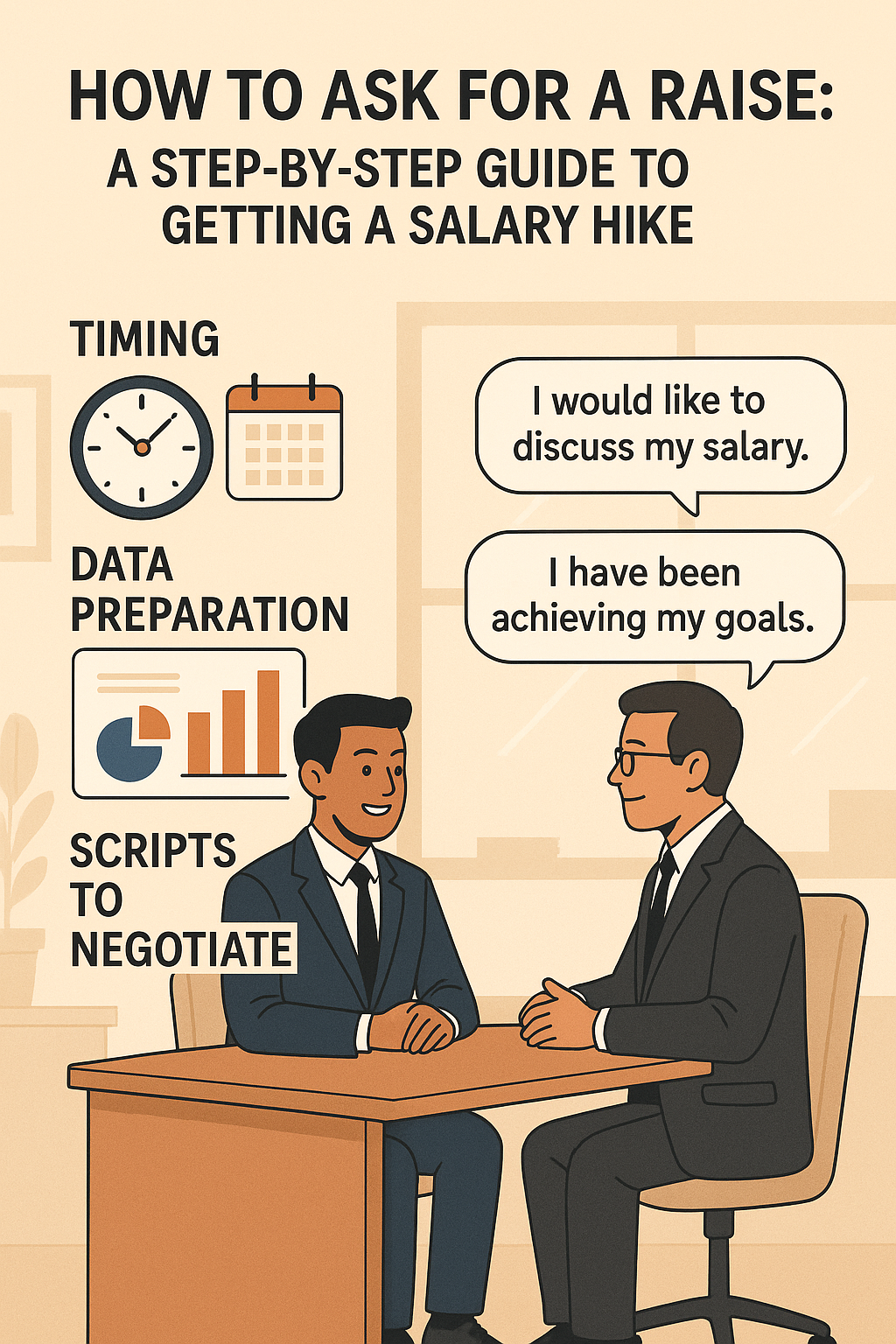
How to Ask for a Raise: A Step-by-Step Guide to Getting a Salary Hike
You are working hard. You are hitting your targets. You are staying late. You assume your boss notices all of this and will reward you with a fat raise at the end of the year.
This is the single biggest career mistake you can make.
In the corporate world, there is no "Karma Department" that automatically rewards hard work. Budgets are tight, and managers are busy. If you don't advocate for your own value, companies are happy to keep paying you the same salary while your market value (and inflation) goes up.
Asking for a raise is terrifying. We fear rejection. We fear looking greedy. We fear damaging the relationship.
But here is the truth: A reasonable manager expects you to ask. It is a standard business transaction. You are selling a service (your labor), and you are renegotiating the price based on increased value.
This guide will stop you from "hoping" for a raise and teach you how to "close" one. Here is your battle plan.
Step 1: Timing is Everything (The "When")
You can have the best argument in the world, but if you ask at the wrong time, the answer will be "No."
The Green Zones (Best times to ask): * 3-4 Months Before the Annual Review: By the time your "Performance Review" happens in March/April, the budget has usually already been decided. You need to plant the seed in December/January. * Immediately After a Big Win: Did you just close a huge deal? Did you successfully launch a project? Strike while the iron is hot. * When Your Responsibilities Increase: If your boss says, "Hey, Sarah left, can you take over her reports?"—that is a trigger for a compensation discussion.
The Red Zones (Worst times to ask): * After a Company Crisis: If layoffs just happened or the quarterly results were bad, read the room. Wait. * Monday Mornings: Your boss is catching up on emails and is stressed. Aim for a Thursday or Friday afternoon when the mood is lighter.
Step 2: Build Your "Brag Sheet" (The Data)
Do not walk into the meeting with feelings ("I feel I work hard"). Walk in with facts. Create a one-page document that lists your contributions over the last 12 months.
- Quantify Your Impact:
- Weak: "I managed the social media accounts."
- Strong: "Grew social media engagement by 30% and generated ₹5 Lakhs in inbound leads."
- Market Research:
- Use JobPe Salary Checker or Glassdoor to find the market rate for your role and location.
- Argument: "The market average for a Senior Developer in Bangalore is ₹20 LPA. I am currently at ₹15 LPA, despite performing at a Senior level."
Step 3: The Meeting (The Script)
Schedule a dedicated 30-minute meeting. Do not spring this on them during a casual coffee chat.
The "Anchor" Script:
Opener: "Thanks for meeting with me. I’ve really enjoyed the challenges of the last year, specifically [Project X]."
The Ask: "I’d like to discuss my compensation. over the past year, I’ve taken on [New Responsibilities] and achieved [Key Result 1 & 2]. Based on this performance and the current market rates for this role, I’m looking to adjust my salary to [Specific Number]."
The Silence: Stop talking. Let them process it. Nervous talking weakens your position.
Step 4: Handling the Objections
Your manager will likely not say "Yes" immediately. They will have standard HR objections. Here is how to parry them.
Objection A: "We don't have the budget right now." * Response: "I understand budgets are tight. If a raise isn't possible today, can we agree on a specific timeline and a set of KPIs? If I hit [Goal X] by [Date], can we commit to reviewing the salary then?"
Objection B: "You are already at the top of the band." * Response: "If I’ve maxed out the salary band for this title, then perhaps we should discuss a promotion to the next level, as my responsibilities already reflect that."
Objection C: "I'll have to ask HR." * Response: "That makes sense. Is there any data or specific information I can provide you to help you make that case to HR?" (Make your boss your partner, not your enemy).
Step 5: What If They Say "No"?
Sometimes, the answer is a hard no. Do not storm out. 1. Pivot to Perks: "If salary is fixed, is there flexibility on other components? Perhaps a one-time bonus, extra vacation days, or a budget for a certification course?" 2. The Exit Strategy: If you are underpaid and they refuse to budge despite your high performance, you have your answer. The market is the only place you will get that raise. Start applying.
Conclusion: You Are Your Own Agent
No one cares about your bank balance as much as you do.
Asking for a raise is not an act of aggression; it is an act of self-respect. Even if you don't get the full amount, the act of asking signals to your management that you are ambitious and aware of your worth.
Before you walk into that room, make sure you know exactly what you are worth. Check the latest salary trends for your specific role and city on JobPe.
For more negotiation strategies, https://jobpe.com.

Creative Content Writer
More from Debojyoti Roy
How to Ask for a Referral on LinkedIn (3 Proven Scripts)
Stop getting rejected by the ATS. Employee referrals are 4x more likely to get hired. Learn the psychology of the "ask" and use our copy-paste scripts to get referred today.
2026-01-08

Video Interview Tips: How to Ace Your Zoom & Teams Interview |
Nervous about your virtual interview? From lighting hacks to eye contact secrets, master these 7 video interview tips to look professional on Zoom, Google Meet, or Teams.
2026-01-08
Best Answer: "Why Did You Leave Your Last Job?"
"Why did you leave your last job?" is a trap. If you complain, you lose. Learn the safe, professional scripts to explain layoffs, toxic bosses, or seeking better opportunities.
2026-01-07
Delete These 6 Things From Your Resume Now
Is your resume outdated? Recruiters spend 6 seconds scanning your CV. Here are the 6 red flags, clichés, and wasted spaces you need to delete immediately to get more interviews.
2026-01-07
Mastering the STAR Method: How to Answer Behavioral Interview Questions
Stuck on "Tell me about a time you failed"? Learn the STAR Method (Situation, Task, Action, Result) to structure your stories and ace behavioral interview questions like a pro.
2026-01-06