


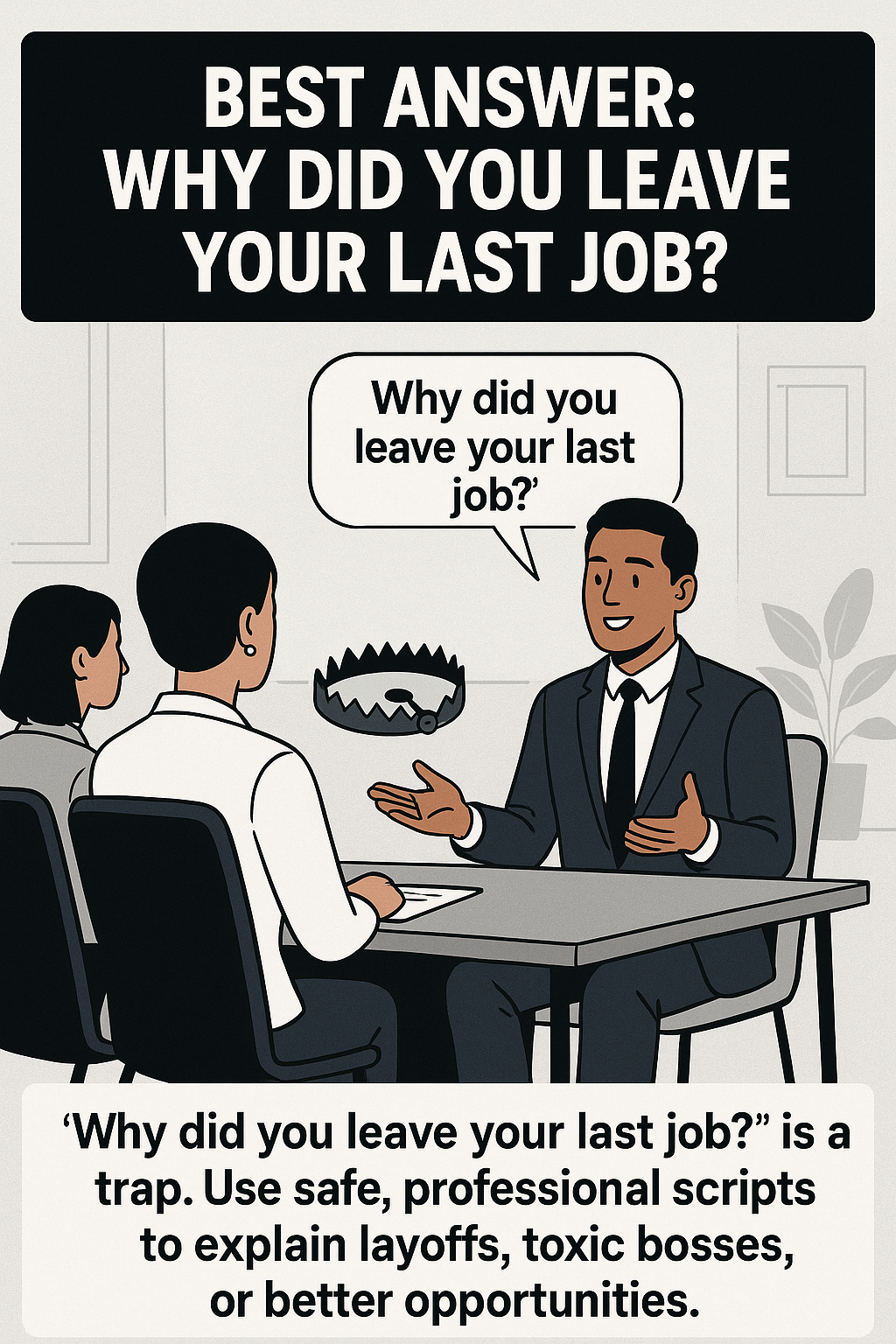
Best Answer: "Why Did You Leave Your Last Job?"
It is the question that makes every candidate sweat.
"So, why did you leave your last company?" (Or: "Why are you looking to leave now?")
The interviewer isn't just asking for a timeline. They are digging for Red Flags. * Did you get fired? * Do you have trouble getting along with people? * Are you a "job hopper" who gets bored easily? * Will you badmouth us when you leave?
If you answer this wrong—by venting about your boss, complaining about the salary, or sounding bitter—the interview is over. Even if you are technically perfect, negativity is a dealbreaker.
Here is the Golden Rule: Keep it Professional, Positive, and Forward-Looking.
Below are the exact scripts to answer this question safely, no matter your situation.
Scenario 1: The "Standard" Answer (Growth)
Use this if you are leaving voluntarily because you simply outgrew the role. This is the safest answer.
The Script:
"I’ve learned a lot at [Current Company] over the last 3 years, specifically in [Skill A]. However, I’ve hit a ceiling in terms of growth opportunities.
I’m ready for a new challenge where I can take on more responsibility in [Skill B], and since my current team is quite small, that path isn't available there. This role at [Your Company] seems like the perfect next step to apply those skills on a larger scale."
Why it works: It frames you as ambitious, not disgruntled.
Scenario 2: The "Toxic Boss" Answer (The Trap)
You hated your boss. The environment was toxic. You want to scream the truth. Don't. If you say, "My boss was a micromanager," the interviewer thinks: "Maybe YOU were hard to manage."
The Script:
"I’m looking for a company culture that aligns better with my working style. I thrive in environments that value autonomy and collaborative problem-solving.
While I enjoyed the work at my last role, the team structure was a bit rigid for me. I’ve heard great things about the collaborative culture here at [Your Company], and that’s a big reason why I applied."
Why it works: You focus on what you want (culture fit), not what you hated.
Scenario 3: The "Layoff" Answer (The Honest Truth)
Layoffs are common now. There is no shame in them. Be direct and brief.
The Script:
"Unfortunately, my role was eliminated as part of a company-wide restructuring that affected 15% of the workforce.
I’m proud of the contributions I made there, including [Big Win], and I’m looking at this as an opportunity to pivot into a sector that is more stable/growing, like this one."
Why it works: It clarifies that the role was eliminated, not that you were fired for performance.
Scenario 4: The "Fired" Answer (The Hardest One)
If you were fired for performance or a mistake, do not lie. Background checks happen. Frame it as a "Learning Experience."
The Script:
"To be honest, the role wasn't the right fit for my strengths. I struggled with [Specific Task], and ultimately, my manager and I agreed it was best to part ways.
It was a difficult lesson, but it taught me that I excel much more in [Different Environment/Role]. That’s why I’m applying for this position—it aligns perfectly with what I do best, which is [Your Strength]."
Why it works: It shows extreme maturity and self-awareness.
The "Red Flag" Phrases to Avoid
- "Whatever you do, don't work there." (Gossip/Bitter).
- "They didn't pay me enough." (Make it about "growth," not just money).
- "I don't know, I just got bored." (Signals you are flaky).
- "My manager was crazy." (Never badmouth a person).
Conclusion: The "Pivot" Technique
No matter which script you use, always end with the Pivot: "...and that brings me to today. I am excited about this role because..."
Don't let the conversation linger on the past. Answer the question, then pivot immediately to why you are the perfect hire for the future.
Practice your "Exit Story" using the JobPe Mock Interview Tool to ensure you sound confident, not defensive.

Creative Content Writer
More from Debojyoti Roy
How to Ask for a Referral on LinkedIn (3 Proven Scripts)
Stop getting rejected by the ATS. Employee referrals are 4x more likely to get hired. Learn the psychology of the "ask" and use our copy-paste scripts to get referred today.
2026-01-08
Video Interview Tips: How to Ace Your Zoom & Teams Interview |
Nervous about your virtual interview? From lighting hacks to eye contact secrets, master these 7 video interview tips to look professional on Zoom, Google Meet, or Teams.
2026-01-08
Delete These 6 Things From Your Resume Now
Is your resume outdated? Recruiters spend 6 seconds scanning your CV. Here are the 6 red flags, clichés, and wasted spaces you need to delete immediately to get more interviews.
2026-01-07
Mastering the STAR Method: How to Answer Behavioral Interview Questions
Stuck on "Tell me about a time you failed"? Learn the STAR Method (Situation, Task, Action, Result) to structure your stories and ace behavioral interview questions like a pro.
2026-01-06
How to Answer "Tell Me About Yourself": The Perfect Interview Script
The first question in every interview is "Tell me about yourself." Don't ramble. Use our "Present, Past, Future" formula to craft a 2-minute elevator pitch that hooks the recruiter instantly.
2026-01-06