


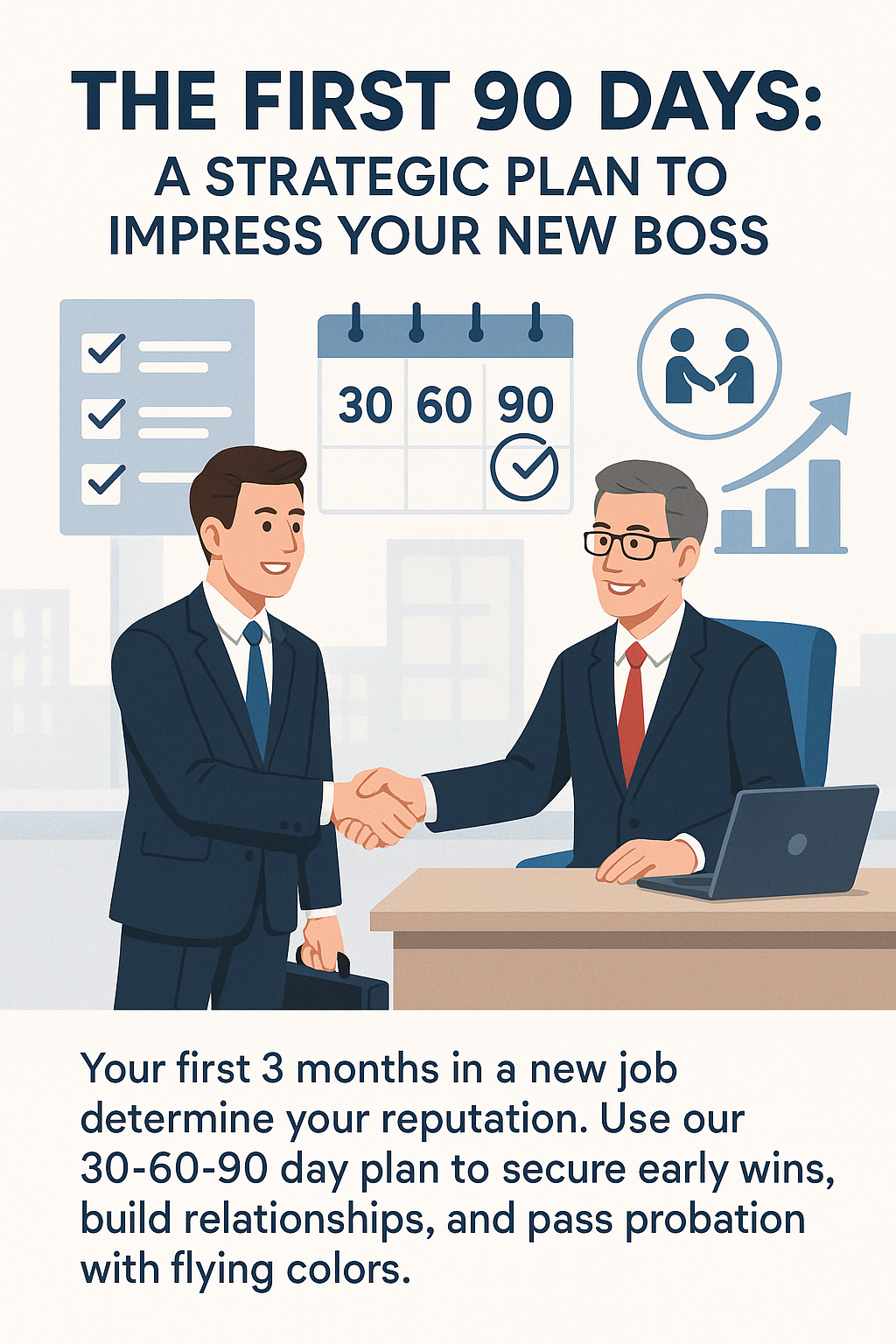
The First 90 Days: A Strategic Plan to Impress Your New Boss and Secure Your Future
You’ve survived the interviews, negotiated the salary, cleared the background check, and finally walked through the doors (or logged into Slack) for Day 1. You might think the hard part is over. In reality, the audition has just begun.
The first 90 days of a new job are widely considered the "danger zone." During this period—often coinciding with your formal probation—employers are watching you closely. They are asking themselves: Did we hire the right person? Can they actually do the job? Do they fit the culture?
First impressions are notoriously sticky. The reputation you build in these first three months will likely stick with you for years. If you start slow, disorganized, or arrogant, you will spend the next year trying to dig yourself out of a hole. If you start strong, you build a "halo effect" where people trust you, advocate for you, and forgive your future mistakes.
Many professionals mistake "starting strong" for "doing everything immediately." They try to change processes on Day 2 or stay silent until Day 60. Both are mistakes. Success in the first 90 days requires a deliberate balance of learning, connecting, and delivering.
This guide provides a week-by-week roadmap—a "30-60-90 Day Plan"—to help you navigate this critical transition, turn your manager into an ally, and cement your status as a high-potential hire.
Month 1: The "Sponge" Phase (Listen and Learn)
Your goal in the first 30 days is not to provide answers; it is to ask the right questions. You are a sponge.
1. The "Listening Tour"
Don't hide at your desk. Set a goal to have a 15-minute coffee chat (virtual or in-person) with: * Your immediate teammates. * Key stakeholders in other departments (Sales, Marketing, Product). * The Question to Ask: "What is the one thing you need from my role to make your job easier?" This identifies your quick wins for later.
2. Understand the "Shadow Culture"
Every company has an employee handbook, but the real rules are unwritten. * How do decisions really get made? (In meetings or over coffee?) * What is the preferred communication style? (Long emails or quick Slacks?) * Who are the unofficial influencers? * Tip: Adapt to the culture before you try to change it.
3. Manager Alignment
In your first week, sit down with your boss and ask: "What does success look like for me in the first 30 days?" Get specific. Do they want you to learn the software? Ship one small feature? Read the archives? Clarity prevents anxiety.
Month 2: The "Contribution" Phase (Secure Quick Wins)
By Day 31, you should stop just absorbing and start outputting. But don't aim for the moon yet; aim for the low-hanging fruit.
1. Identify and Solve a "Pebble"
A "pebble" is a small, annoying problem that everyone complains about but no one fixes. * Is the file organization a mess? Clean it up. * Is there a manual report that takes hours? Automate it. * Why: Fixing a pebble shows initiative and makes you immediately useful to the team without stepping on anyone's toes.
2. Speak Up in Meetings
You’ve been silent for a month. Now, start contributing. * You don't need to dominate the room. A simple, "Building on what Sarah said, have we considered..." adds value. It signals you are engaged and thinking critically.
3. The 60-Day Check-In
Don't wait for your boss to review you. Schedule a 15-minute feedback session. * Script: "I’ve been here 60 days now. I feel like I'm getting a handle on [Project X]. Is there anything you'd like to see me do differently in the next month?"
Month 3: The "Strategy" Phase (Long-Term Value)
By Day 61, you are no longer the "new guy/girl." You are a fully functioning member of the team. Now you can start flexing your expertise.
1. Propose a larger initiative
Now that you understand the context and the culture, you can suggest improvements. * "I've noticed our lead generation process slows down at this stage. Based on my experience at [Previous Job], we could try [Strategy Y]. I’d love to run a small pilot next week."
2. Own Your KPIs
Stop asking for permission for every task. Take full ownership of your deliverables. Show your manager that they can trust you to handle your workload without micromanagement.
3. The "Probation" Review
If you’ve followed this plan, your formal probation review should be a celebration, not an interrogation. Bring a list of your "Quick Wins" and your plan for the next 6 months.
Common Mistakes to Avoid
- The "Savior" Complex: Walking in on Day 1 and saying, "This is all wrong; at my old company, we did it better." You will be hated. Respect the history of why things are the way they are before you criticize them.
- The "Ghost": Being too afraid to ask questions. If you pretend to know things you don't, you will make a major mistake later. It is better to ask a "dumb" question on Day 5 than to make a dumb mistake on Day 50.
- Ignoring Peers: Focusing only on impressing the boss while ignoring your teammates. Your peers are the ones who will help you (or let you fail) when the boss isn't looking.
Conclusion: Trust is Earned in Inches
The first 90 days are intense, but they are finite. By treating this period as a structured project—with distinct phases for learning, doing, and leading—you remove the guesswork. You demonstrate that you are not just a talented hire, but a strategic professional who manages their own success.
Once you’ve conquered these 90 days, you’re ready to look further ahead. Start planning your long-term growth by identifying the skills you'll need for your next promotion using JobPe’s Career Path Explorer.
For more resources to help you thrive in your new role, https://jobpe.com.

Creative Content Writer
More from Debojyoti Roy

How to Handle Toxic Coworkers: The Slacker, The Gossip, and The Credit Stealer
You can't choose your colleagues. Learn how to deal with the most common office villains—the Credit Stealer, the Chronic Complainer, and the Slacker—without losing your professional cool.
2026-01-20

The 4-Day Work Week: Will AI Finally Make It a Reality?
Can Artificial Intelligence unlock the 4-day work week? We analyze how AI productivity tools could shorten the work week, the economic obstacles standing in the way, and how to position yourself for an output-based career.
2026-01-20

Best Answer to "What Is Your Greatest Weakness?"
Stop saying "I'm a perfectionist." Learn how to answer the "Greatest Weakness" interview question with authentic, safe examples that show growth and self-awareness.
2026-01-19
How to Ask for a Referral on LinkedIn (3 Proven Scripts)
Stop getting rejected by the ATS. Employee referrals are 4x more likely to get hired. Learn the psychology of the "ask" and use our copy-paste scripts to get referred today.
2026-01-08
Video Interview Tips: How to Ace Your Zoom & Teams Interview |
Nervous about your virtual interview? From lighting hacks to eye contact secrets, master these 7 video interview tips to look professional on Zoom, Google Meet, or Teams.
2026-01-08