


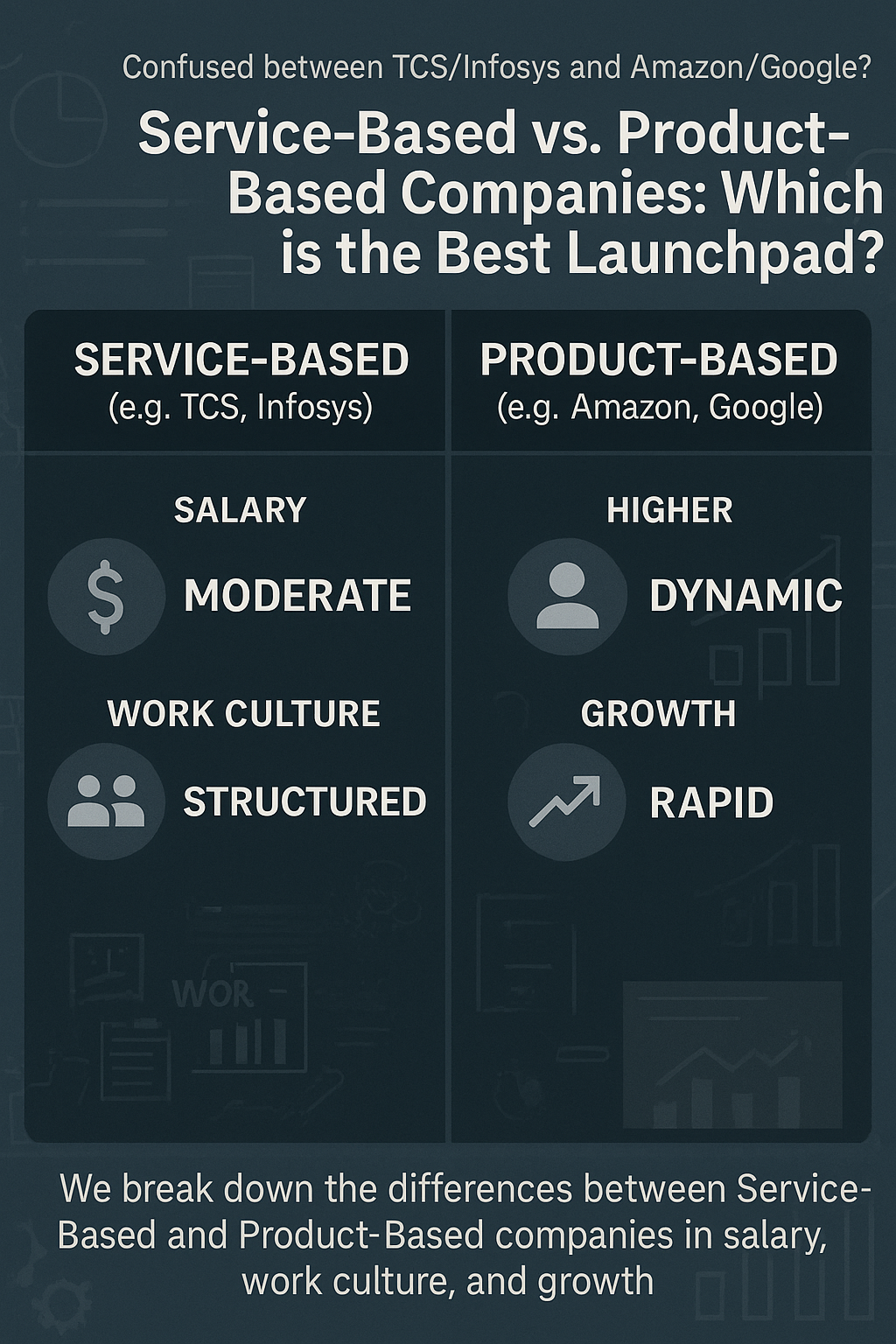
Service-Based vs. Product-Based Companies: Which is the Best Launchpad for Your Career?
For fresh engineering graduates and IT professionals in India, the job market is often viewed through a binary lens. On one side, you have the giants of the service industry—companies like TCS, Infosys, Wipro, and Accenture—known as mass recruiters who hire thousands of freshers every year. On the other side, you have the "dream" product companies—global titans like Google, Amazon, and Microsoft, along with unicorns like Uber, Zomato, and Swiggy—known for innovation and sky-high salaries.
The debate of "Service vs. Product" is a constant topic in college canteens and online forums. There is often a stigma attached to service companies ("it's just maintenance work") and a halo around product companies ("it's where the real engineering happens"). But is the choice really that black and white?
While product companies certainly offer higher initial payouts, service-based companies provide stability, variety, and a unique set of learning opportunities that are often undervalued. Choosing the right path requires looking beyond the prestige and understanding the fundamental differences in business models, work culture, and long-term career trajectories.
This guide provides a balanced, deep-dive comparison to help you decide which environment aligns best with your skills, your ambition, and your career stage.
The Business Model Difference: Why It Matters
To understand your role, you must understand how the company makes money.
Service-Based Companies (The Consultants) * The Model: They sell services (time and expertise) to other clients. Client A needs a website; the service company builds it. Client B needs their servers maintained; the service company maintains them. * Your Role: You are essentially a consultant working for a client. The focus is on execution, customer satisfaction, and billable hours. You build what the client asks for.
Product-Based Companies (The Creators) * The Model: They build and sell their own product. Google sells search/ads; Uber sells rides. They invest heavily in R&D to create something valuable. * Your Role: You are an inventor. The focus is on innovation, quality, and solving user problems. You figure out what to build to make the product better.
1. The Work Culture: Process vs. Problem Solving
The day-to-day experience differs drastically.
- Service-Based: The culture is generally process-driven. Because you are serving external clients, deadlines are rigid, and adherence to protocols is strict. You might work on a "maintenance project" for a US bank, fixing bugs in legacy code. The advantage? You get exposed to varied domains (banking one year, healthcare the next).
- Product-Based: The culture is problem-driven. "How do we make this page load 10ms faster?" or "How do we increase user retention?" You own a specific feature or module end-to-end. The pace can be intense, but you have more autonomy and creative freedom.
2. The Hiring Process: Aptitude vs. Algorithms
Getting in requires different preparation strategies.
-
Service-Based: The barrier to entry is lower. They typically test for:
- Aptitude: Math, logic, and English skills.
- Basic Coding: Fundamental programming concepts (loops, arrays).
- Communication: Ability to speak clearly (for client interaction).
- Goal: They hire for "trainability."
-
Product-Based: The barrier is high. They test for:
- Data Structures & Algorithms (DSA): Hardcore problem-solving skills.
- System Design: (For experienced roles) How to architect scalable apps.
- Cultural Fit: Behavioral rounds.
- Goal: They hire for "engineering excellence."
3. Salary and Compensation: The "Great Divide"
This is the most talked-about difference.
- Service-Based: Starting salaries for freshers typically range from ₹3.5 Lakhs to ₹5 Lakhs per annum. Increases are steady but often modest (5-10% annually). The upside is stability; layoffs are historically less common (though this is changing).
- Product-Based: Starting salaries can range from ₹10 Lakhs to ₹40 Lakhs+ per annum, often including stock options (ESOPs/RSUs). The financial trajectory is exponential. However, the expectations are equally high, and "performance improvement plans" (PIPs) are real risks for underperformers.
4. Career Growth: The Ladder vs. The Rocket Ship
- Service-Based: Growth is often linear and tied to designations (System Engineer -> Senior Engineer -> Team Lead -> Project Manager). You eventually move from coding to management. It is a great place to learn corporate professionalism, client management, and process discipline.
- Product-Based: Growth is tied to impact. You can remain an "Individual Contributor" (coding every day) for 20 years and still earn as much as a VP. You grow by solving harder problems, not just by managing more people.
The Verdict: Which One Should You Choose?
Choose a Service-Based Company If: * You are just starting and want a structured training program to learn the basics. * You value job security and a predictable 9-to-5 schedule (mostly). * You want to explore different industries (banking, retail, auto) before settling. * You enjoy the "management" and "people" side of IT more than raw coding.
Choose a Product-Based Company If: * You are passionate about coding and technology ("Geek at heart"). * You want to solve complex, scalable problems that impact millions of users. * You are financially ambitious and willing to handle high-pressure environments. * You want to be judged on your output quality, not your timesheet.
The "Bridge" Strategy
Many successful developers start in a service-based company to get their foot in the door, spend 2 years mastering their tech stack and DSA on weekends, and then "switch" to a product-based company for a massive salary hike. This is a proven and viable career path.
Your first job is not your final destination. Whether you start in a cubicle at Infosys or a beanbag at Swiggy, the key is to keep learning.
To prepare for the specific interview styles of these companies, use JobPe's Coding Practice for product roles and our general Aptitude Guides for service roles.
For more insights into navigating the tech landscape, https://jobpe.com.

Creative Content Writer
More from Debojyoti Roy
Beating the Applicant Tracking System (ATS): The Ultimate Guide to Getting Past the Bot
Is your resume getting rejected instantly? It might be the ATS. Learn how Applicant Tracking Systems work, how to format your resume to beat the bot, and the keyword strategies that get you noticed.
2025-12-10
Mastering the Cold Email: How to Land a Job Without Applying Online
Tired of the "black hole" of online applications? Learn the art of the cold email. We provide strategies, subject lines, and templates to reach hiring managers directly.
2025-12-10
How to Ask for a Raise (Without Being Awkward): A Step-by-Step Guide
Don't wait for your annual appraisal. Learn the strategic way to ask for a raise, build your business case, and use our scripts to get the salary hike you deserve.
2025-12-10
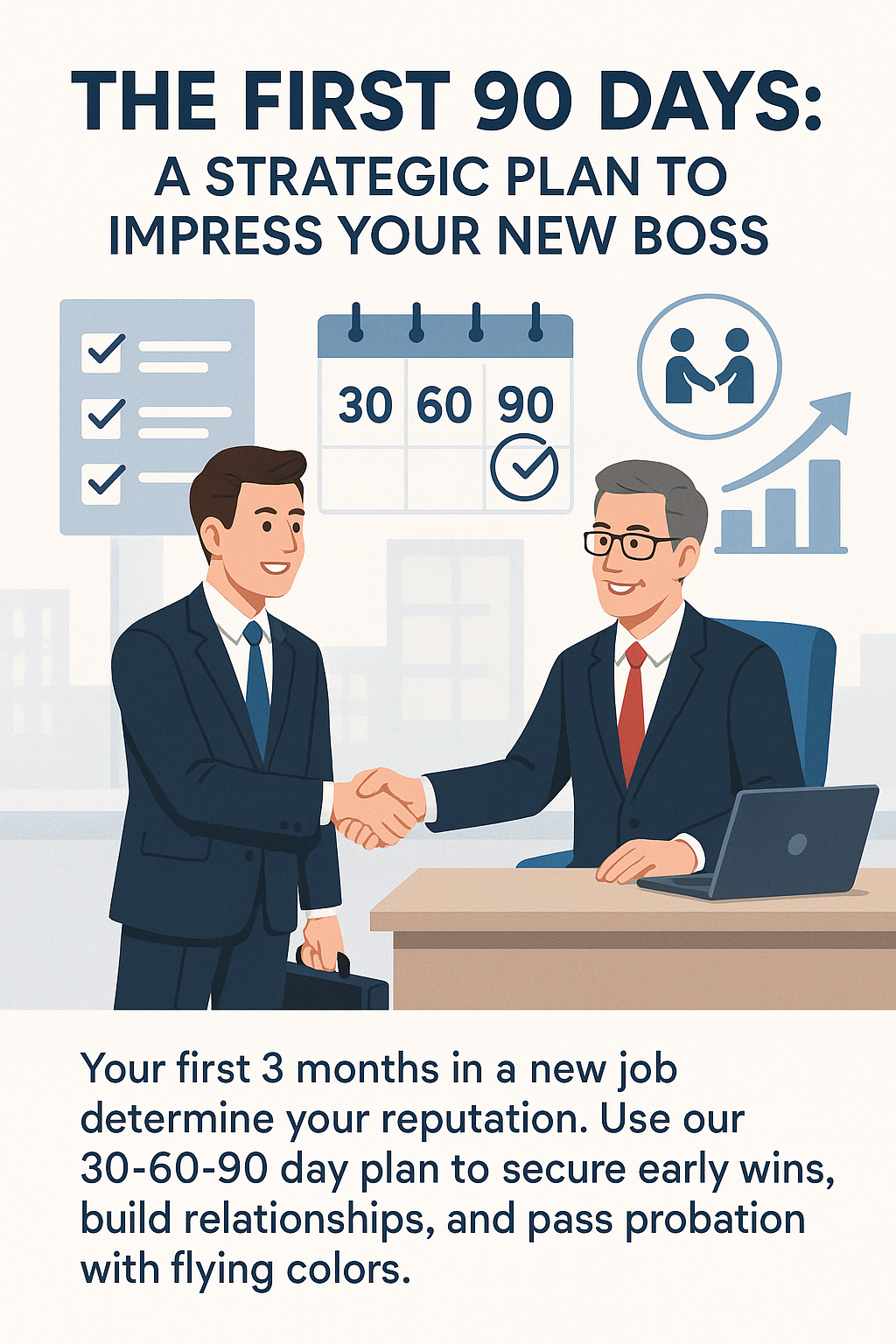
The First 90 Days: A Strategic Plan to Impress Your New Boss
Your first 3 months in a new job determine your reputation. Use our 30-60-90 day plan to secure early wins, build relationships, and pass probation with flying colors.
2025-12-09
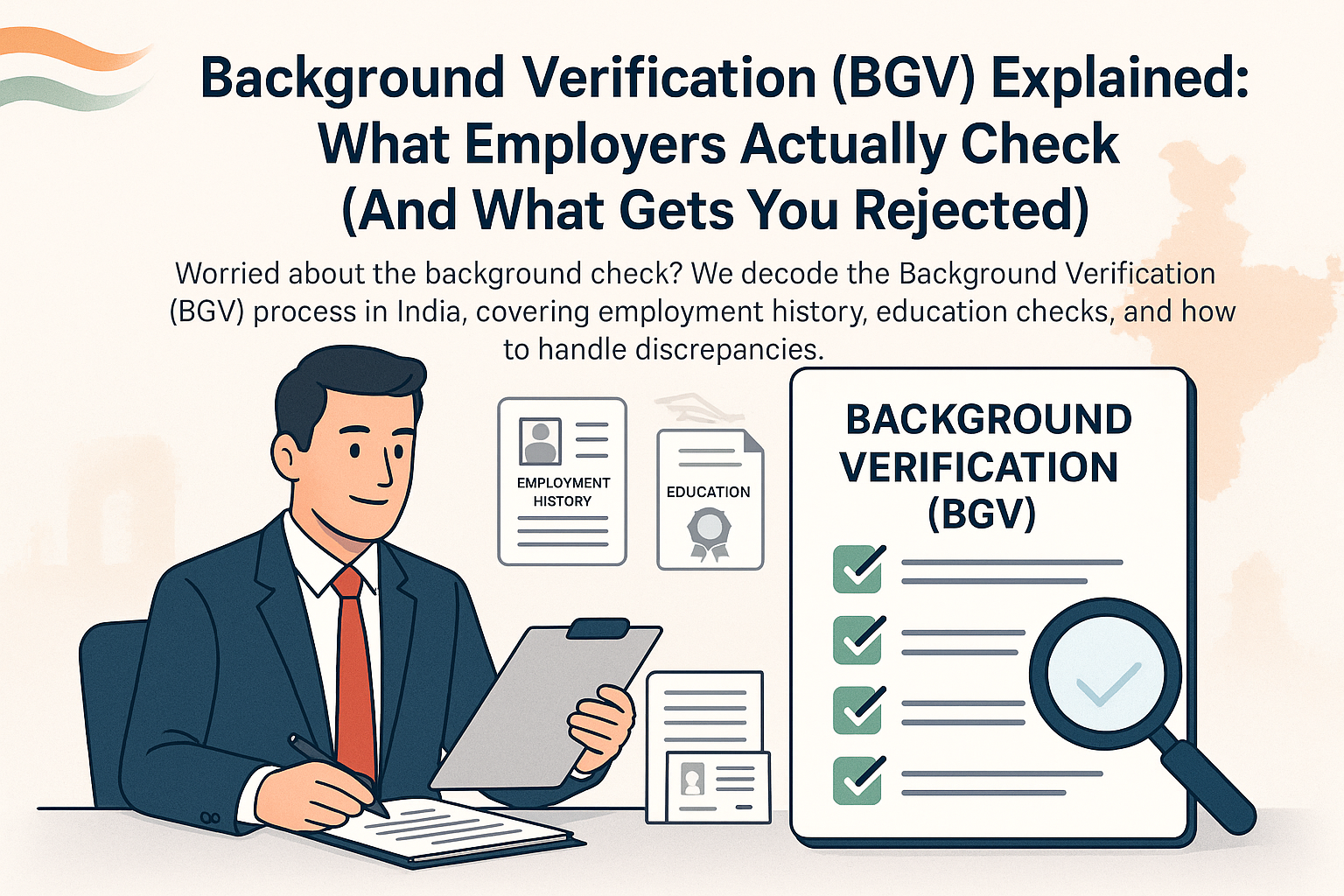
Background Verification (BGV) Explained: What Employers Actually Check (And What Gets You Rejected)
Worried about the background check? We decode the Background Verification (BGV) process in India, covering employment history, education checks, and how to handle discrepancies.
2025-12-09