


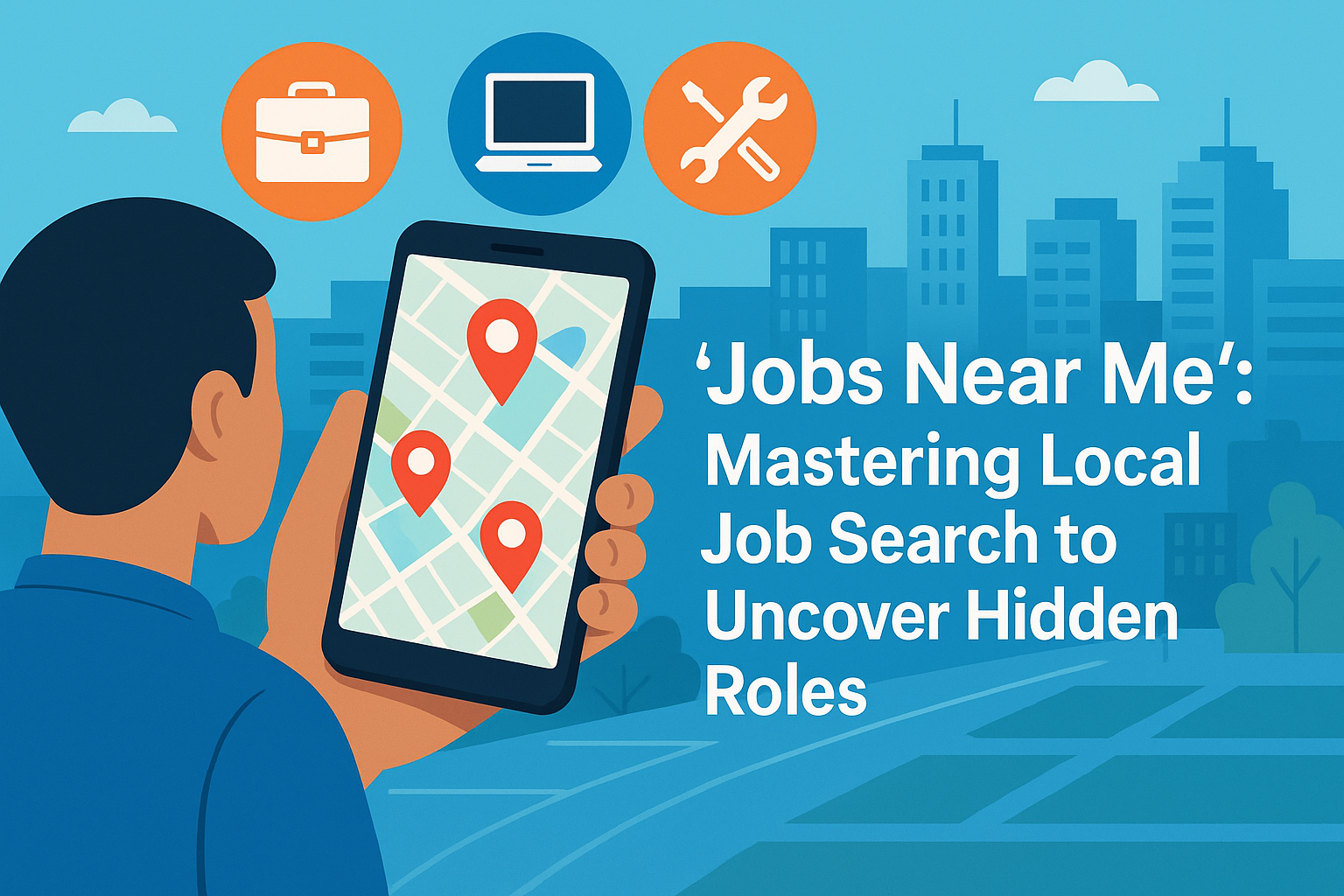
"Jobs Near Me": Mastering Local Job Search to Uncover Hidden Roles
Type "jobs near me" into Google, and you will get millions of results. It is one of the most popular search queries in the world, a testament to the universal desire for a short commute and a connection to one's local community. But for most job seekers, this search leads to a cluttered mess of results: expired listings, scams, or roles that are "near" only if you consider a 50-kilometer commute acceptable.
Finding a great job in your specific locality—whether it's a specific neighborhood in Mumbai, a tech park in Bengaluru, or a tier-2 city like Nagpur—requires more than just a generic keyword search. It requires a hyper-local strategy. Many of the best local jobs, especially in small-to-medium businesses (SMBs), retail, healthcare, and education, never make it to the massive national job boards. They are part of the "hidden local market," filled through community networks, local storefront signs, and word-of-mouth.
If you are tired of long commutes and want to work closer to home, or if you are looking for opportunities in a specific town, you need to change your tactics. You need to stop searching like a national candidate and start searching like a local insider.
This guide is your playbook for mastering the local job search. We will move beyond the basic search bar and show you how to use tools like Google Maps, community groups, and hyper-local keywords to uncover the hidden gems right in your backyard.
Strategy 1: Master the "Google for Jobs" Interface
When you search "jobs near me," Google generates a special blue box of listings. This is the "Google for Jobs" widget, and it is a powerful aggregator. * Use the "Location" Filter Properly: Don't just rely on your GPS. Manually enter your specific zip code or neighborhood. * Refine by Distance: Use the distance filter to narrow results to "2 km" or "5 km" or "10 km." This is the best way to find jobs that are truly walkable or a short drive away. * Set Up Local Alerts: You can save this specific, radius-based search as an alert directly within Google. This ensures you are notified the moment a local business posts a role that matches your criteria.
Strategy 2: The "Google Maps" Hack (Finding the Hidden Companies)
This is a secret weapon for finding small businesses that rarely post on big job boards. 1. Open Google Maps: Zoom in on the specific area where you want to work. 2. Search for Your Industry: Instead of "jobs," search for "marketing agencies," "software companies," "accounting firms," or "hospitals" in that area. 3. Browse the Results: You will see a map full of businesses you probably didn't know existed. 4. Visit Their "Careers" Page: Click on their website link directly from Maps. Many small businesses only post jobs on their own website's "Work With Us" page. 5. Cold Outreach: If they don't have a jobs page, find their general email or phone number on Maps and send a polite inquiry. "I live in the neighborhood and am an experienced [Role]. I admire your business and wanted to ask if you are currently hiring." Local businesses often love hiring locals because they know you won't quit due to a long commute.
Strategy 3: Tap into Hyper-Local Digital Communities
Local jobs often circulate in local groups before they hit the web. * Facebook Community Groups: Search for "[City Name] Jobs," "[Neighborhood Name] Community," or "Jobs in [District]." Join these groups. Small business owners often post "Hiring Now" graphics here for immediate needs. * WhatsApp and Telegram Groups: In many Indian cities, informal job-sharing groups on WhatsApp are huge. Ask your friends or local network if they know of any "local job alert" groups for your city. * Nextdoor (or similar neighborhood apps): If active in your area, these platforms are great for finding local gigs, tutoring roles, or part-time work posted by neighbors.
Strategy 4: Use Location-Specific Keywords on Aggregators
On platforms like JobPe, don't just search for "Sales Executive."
* Be Specific: Search for "Sales Executive" "Andheri" or "Software Engineer" "Whitefield". Using the specific area name in quotes forces the search engine to look for that exact location in the job description.
* Look for "Walk-in" Listings: Add "Walk-in" to your local search. Walk-in interviews are geographically bound by definition—companies expect locals to show up.
Strategy 5: The "Offline" Audit
Sometimes, the best way to find a local job is to disconnect from the internet. * The "Help Wanted" Sign: For retail, hospitality, and service jobs, the window sign is still king. Take a walk through your local high street or business park. * Local Newspapers: In tier-2 and tier-3 cities, regional newspapers (and their classifieds) are still a primary hiring channel for local businesses. * Chambers of Commerce: Check the website of your local Chamber of Commerce. They often have a member directory or a local job board for businesses in the district.
Conclusion: Think Small to Win Big
The "jobs near me" search is not just about convenience; it's about quality of life. Cutting your commute by an hour a day gives you back 5 hours a week—that's 250 hours a year of your life reclaimed.
By combining the digital power of location-based search with the old-school tactics of mapping and community networking, you can uncover a layer of the job market that is invisible to the average applicant. Your next great opportunity might not be in a distant business district; it might be just around the corner.
To automate your local hunt, be sure to set up job alerts with your specific city or neighborhood as a keyword.
For more tools to help you find the right job in the right place, https://jobpe.com.

Creative Content Writer
More from Debojyoti Roy
Beating the Applicant Tracking System (ATS): The Ultimate Guide to Getting Past the Bot
Is your resume getting rejected instantly? It might be the ATS. Learn how Applicant Tracking Systems work, how to format your resume to beat the bot, and the keyword strategies that get you noticed.
2025-12-10
Mastering the Cold Email: How to Land a Job Without Applying Online
Tired of the "black hole" of online applications? Learn the art of the cold email. We provide strategies, subject lines, and templates to reach hiring managers directly.
2025-12-10
How to Ask for a Raise (Without Being Awkward): A Step-by-Step Guide
Don't wait for your annual appraisal. Learn the strategic way to ask for a raise, build your business case, and use our scripts to get the salary hike you deserve.
2025-12-10

The First 90 Days: A Strategic Plan to Impress Your New Boss
Your first 3 months in a new job determine your reputation. Use our 30-60-90 day plan to secure early wins, build relationships, and pass probation with flying colors.
2025-12-09
Background Verification (BGV) Explained: What Employers Actually Check (And What Gets You Rejected)
Worried about the background check? We decode the Background Verification (BGV) process in India, covering employment history, education checks, and how to handle discrepancies.
2025-12-09