


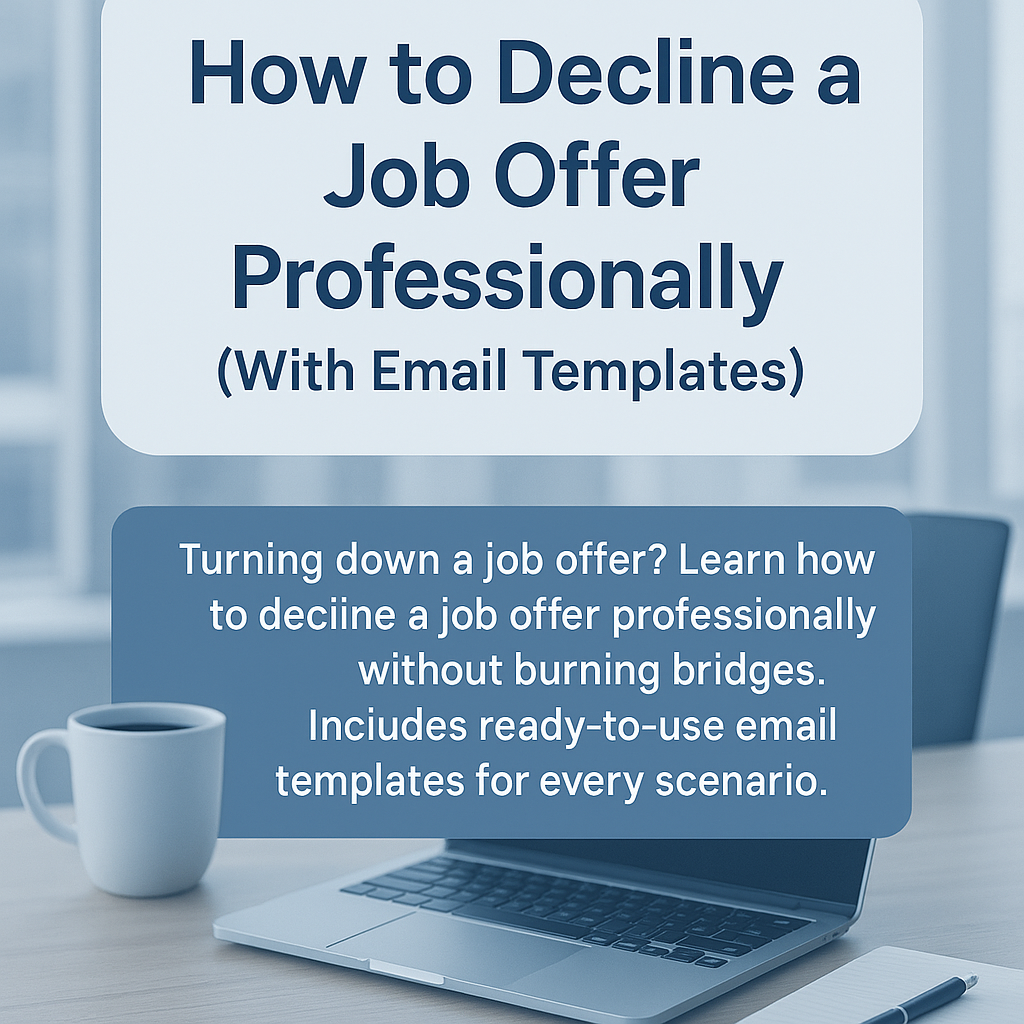
How to Decline a Job Offer Professionally (With Email Templates)
The job search is usually focused on getting to "Yes." You work hard to get the interview, to impress the hiring manager, and to secure the offer. But sometimes, the right answer is "No." Maybe you’ve received a better offer from another company. Maybe the salary didn't meet your expectations. Or perhaps, after learning more about the role and culture, your gut is simply telling you it's not the right fit.
Declining a job offer is a "good problem to have," but it can also be surprisingly stressful. You might feel guilty about wasting the recruiter's time or worried about offending a hiring manager you genuinely liked. It’s tempting to procrastinate, hoping the problem will go away, or to send a vague, apologetic text message.
However, how you say "no" is just as important for your professional reputation as how you say "yes." The world is small. The recruiter you ghost today might be the hiring manager at your dream company five years from now. The company you turn down today might be the perfect fit for you in the future.
Declining an offer with grace, professionalism, and gratitude is a strategic career move. It preserves your relationship with the company and leaves the door open for future opportunities. This guide will provide you with a simple framework for turning down a job politely and professional email templates you can adapt for any scenario.
The Rules of the Game: How to Handle the Rejection
Before you hit send, keep these three golden rules in mind.
1. Do It Promptly
Once you have made your final decision, do not sit on it. The company is waiting for your answer to move forward—either with onboarding you or with offering the role to their second-choice candidate. Delaying your "no" is disrespectful to the company and unfair to the other candidate who is waiting in limbo. Letting them know quickly allows everyone to move on.
2. Be Grateful and Professional
Always start and end with gratitude. Someone advocated for you, fought for budget for you, and invested time in getting to know you. Acknowledge that effort. Keep the tone professional, polite, and positive.
3. Be Brief (You Don't Need to Over-Explain)
You do not need to write a novel explaining every detail of your decision. You don't need to justify your choice to them. A simple, clear reason is sufficient. "I've accepted another offer that aligns more closely with my long-term goals" is a perfect, unarguable reason. Avoid getting into nitty-gritty details about why their company wasn't good enough.
Email Templates for Every Scenario
Use these templates as a starting point, but customize them to sound like you.
Scenario 1: The Standard Decline (You Accepted Another Offer)
This is the most common scenario. You simply found a better match elsewhere.
Subject: Job Offer - [Your Name]
Dear [Hiring Manager's Name],
Thank you so much for offering me the position of [Job Title] at [Company Name]. I have truly enjoyed getting to know you and the team during the interview process, and I was very impressed with [mention one specific thing you liked, e.g., the company's vision/the team's energy].
However, after careful consideration, I have decided to accept another opportunity that aligns more closely with my current career goals.
This was not an easy decision, as I have a great deal of respect for [Company Name]. I appreciate the time and effort you invested in my application.
I wish you and the team all the best in finding the right candidate for this role. I hope our paths cross again in the future.
Sincerely,
[Your Name]
Scenario 2: The "Not a Good Fit" Decline (No Other Offer)
Sometimes you just know it's not right, even if you don't have another job lined up.
Subject: Job Offer - [Your Name]
Dear [Hiring Manager's Name],
Thank you very much for extending the offer to join [Company Name] as a [Job Title]. I appreciate the time you took to discuss the role and the company's direction with me.
After giving it significant thought, I have decided to decline the offer. While I admire what the company is doing, I feel that this role is not the right fit for my professional path at this time.
I want to thank you again for the opportunity and your hospitality during the interview process. I wish you the best of luck with your search.
Best regards,
[Your Name]
Scenario 3: The "Bad Timing/Salary" Decline (Leaving the Door Open)
Use this if you genuinely liked the company but the compensation or timing just didn't work out.
Subject: Regarding the [Job Title] Offer - [Your Name]
Dear [Hiring Manager's Name],
Thank you for offering me the [Job Title] position. I have been very impressed with the team and the work you are doing at [Company Name].
However, I have decided to decline the offer at this time. As we discussed, the salary package does not meet the financial requirements I need to make a move right now. [OR: The timing isn't quite right for me to make this transition.]
I have a high regard for [Company Name] and would love to stay in touch should a future role open up that might be a better match for my [seniority level/salary expectations].
Thank you again for your time and consideration.
Sincerely,
[Your Name]
Scenario 4: Reneging (Declining After You Accepted)
This is the most dangerous scenario and should be avoided if at all possible. It burns bridges. If you must do it (e.g., due to a family emergency or a once-in-a-lifetime offer), be incredibly apologetic and humble. This is best done via a phone call, followed by an email.
Subject: Important Update - [Your Name]
Dear [Hiring Manager's Name],
I am writing to you with a sincere apology. Although I previously accepted the offer for the [Job Title] position, I must respectfully withdraw my acceptance.
Since signing, [brief, vague reason: my personal circumstances have changed significantly / I received an unexpected offer that I simply cannot turn down]. This was a difficult decision, and I deeply regret any disruption this causes you and the team.
I have the utmost respect for [Company Name] and I am truly sorry for the inconvenience. I wish you nothing but success.
Sincerely,
[Your Name]
Conclusion: The Classy "No"
Declining a job offer is a business decision, not a personal rejection. By handling it with professionalism, speed, and grace, you protect your reputation and ensure that you are remembered as a class act. You never know—the manager you say "no" to today might be the one referring you for your dream job tomorrow.
Now that you've made your decision, focus on your next steps. If you've accepted another role, get ready for your first day with our guide to Your First 90 Days. If you're still looking, keep your search active and efficient with targeted job alerts.
For more tools and advice to help you manage your career decisions, https://jobpe.com.

Creative Content Writer
More from Debojyoti Roy
How to Handle Toxic Coworkers: The Slacker, The Gossip, and The Credit Stealer
You can't choose your colleagues. Learn how to deal with the most common office villains—the Credit Stealer, the Chronic Complainer, and the Slacker—without losing your professional cool.
2026-01-20

The 4-Day Work Week: Will AI Finally Make It a Reality?
Can Artificial Intelligence unlock the 4-day work week? We analyze how AI productivity tools could shorten the work week, the economic obstacles standing in the way, and how to position yourself for an output-based career.
2026-01-20

Best Answer to "What Is Your Greatest Weakness?"
Stop saying "I'm a perfectionist." Learn how to answer the "Greatest Weakness" interview question with authentic, safe examples that show growth and self-awareness.
2026-01-19
How to Ask for a Referral on LinkedIn (3 Proven Scripts)
Stop getting rejected by the ATS. Employee referrals are 4x more likely to get hired. Learn the psychology of the "ask" and use our copy-paste scripts to get referred today.
2026-01-08

Video Interview Tips: How to Ace Your Zoom & Teams Interview |
Nervous about your virtual interview? From lighting hacks to eye contact secrets, master these 7 video interview tips to look professional on Zoom, Google Meet, or Teams.
2026-01-08