


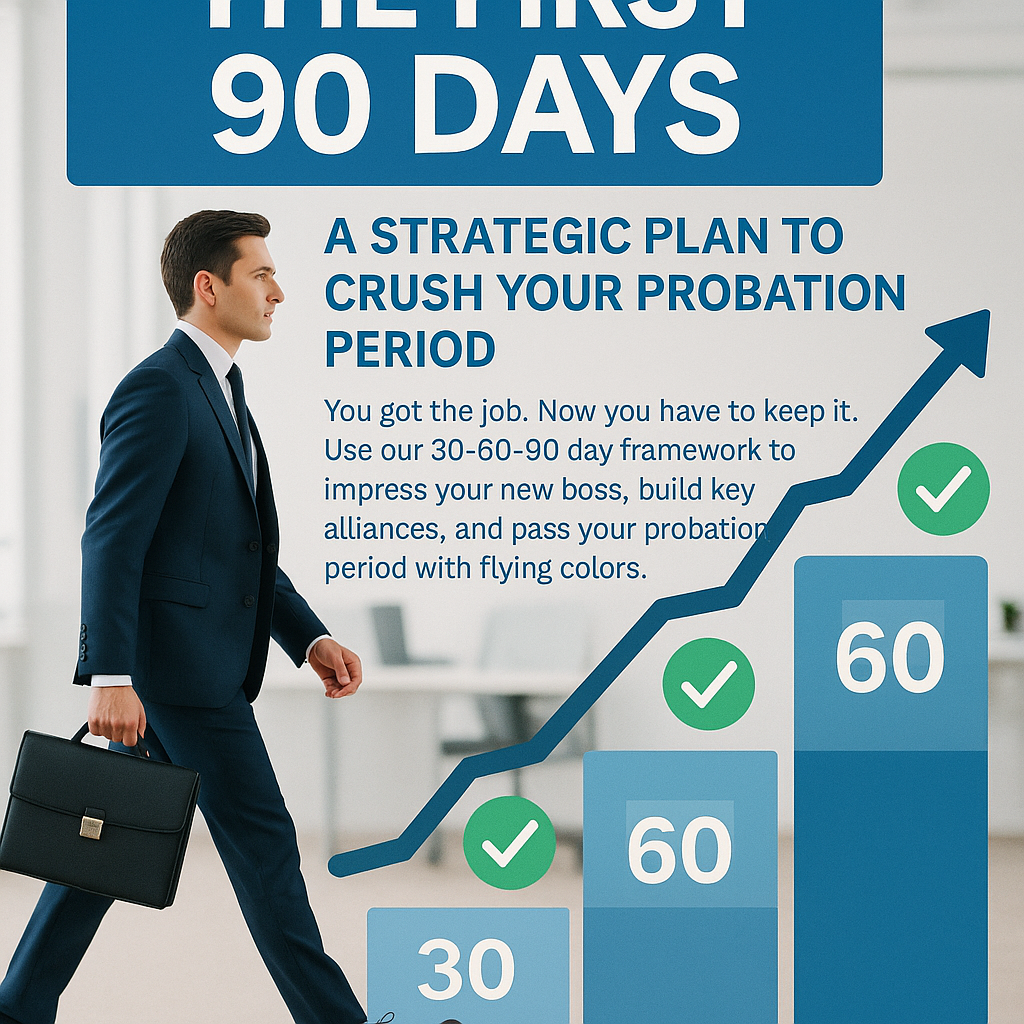
The First 90 Days: A Strategic Plan to Crush Your Probation Period
Getting the job offer is a victory, but it is not the end of the race. It is just the starting line.
For the first 3-6 months, you are in the Probation Period. Legally and culturally, you are on trial. The company is asking: "Did we make the right choice? Or is this person a bad hire?"
Many professionals treat the first few months as a "Honeymoon Phase." They stay quiet, wait for instructions, and try not to make waves. This is a mistake.
The first 90 days are when your reputation is cemented. If you are labeled as "passive" or "slow" in month 1, it will take you years to shake that label. If you are labeled as a "high-potential driver," opportunities will flow to you automatically.
You need a plan. You need to move from "Learning" to "Contributing" as fast as possible. This guide provides a proven 30-60-90 Day Framework to navigate your onboarding and secure your future at the company.
Phase 1: Days 1–30 (The Sponge Phase)
Your goal in the first month is simple: Learn everything without being annoying. You are a sponge.
1. The "Coffee Tour" (Relationship Mapping)
Don't just sit at your desk. Your number one priority is to build alliances. * The Goal: Meet 10 people in 10 days. * The Script: "Hi [Name], I’m the new [Role]. I’m trying to understand how my team fits in with yours. Do you have 15 minutes for a quick coffee/chat so I can learn what you do?" * Who to meet: Not just your boss. Meet the person who sits next to you, the IT guy (he will save your life later), and cross-functional peers.
2. Understand the "North Star"
Sit down with your manager in Week 1 and ask the "Golden Question":
"What does success look like for me in the first 90 days? If we sit down here in 3 months, what specific results would make you say I was a great hire?" Write down their answer. This is now your exam paper.
3. Master the Stack
Do not be the person asking "How do I log in to Jira?" in Week 4. Spend your evenings mastering the internal tools, the product, and the acronyms.
Phase 2: Days 31–60 (The "Quick Win" Phase)
Now that you know where the bathroom is and who the stakeholders are, it’s time to add value. You are still learning, but you need to start giving back.
1. Identify the "Low-Hanging Fruit"
Look for small, annoying problems that existing employees are too busy to fix. * Is the shared folder messy? Organize it. * Is the weekly report always late? Offer to automate it. * The Impact: These small wins build "Political Capital." They show you are proactive and helpful.
2. Speak Up in Meetings
In Month 1, you listened. In Month 2, you participate. * The Rule: Aim to make one value-added comment per meeting. * The Caveat: Do not be the "New Guy" who says, "At my old company, we did it better." Everyone hates that guy. Phrase it as a question: "Have we experimented with X approach before?"
3. Ask for Early Feedback
Don't wait for the 90-day review. Ask for a "Temperature Check" at 45 days. * The Script: "I’ve been here 6 weeks now. Is there anything you’d like me to focus more on or dial back on?"
Phase 3: Days 61–90 (The Owner Phase)
By Month 3, you are no longer the "new hire." You are a fully functioning member of the team.
1. Own a Project
Take full responsibility for a deliverable. Move from "helping" on a project to "owning" a project. You should be the one sending the updates, managing the timeline, and taking the heat if it fails.
2. Propose a Solution
You have fresh eyes. You see inefficiencies that old employees ignore. * The Strategy: Prepare a short proposal (1-2 pages) for a process improvement. Present it to your boss. Even if they say no, they will be impressed by your initiative.
3. The 90-Day Review
If you followed this plan, this meeting will be a celebration, not an interrogation. * Preparation: Bring a "Brag Sheet." List your Quick Wins from Phase 2 and your Project Ownership from Phase 3. Remind them of the value you created.
The Biggest Mistakes to Avoid
- The "Know-It-All": Trying to change everything in Week 1. Respect the existing culture before you try to change it.
- The "Ghost": Hiding at your desk and only talking to your boss. Invisibility is fatal.
- The "Burnout": Working 14 hours a day to impress. You can't sustain this. Set sustainable boundaries early.
Conclusion: Trust is Earned
The First 90 Days are about building Trust. * Trust that you are competent. * Trust that you are reliable. * Trust that you are a cultural fit.
Once you cross the 90-day mark with that trust established, you stop surviving and start thriving.
To help you track your progress, download the JobPe 30-60-90 Day Checklist Template and keep it on your desk.
For more career acceleration tips, https://jobpe.com.

Creative Content Writer
More from Debojyoti Roy

How to Handle Toxic Coworkers: The Slacker, The Gossip, and The Credit Stealer
You can't choose your colleagues. Learn how to deal with the most common office villains—the Credit Stealer, the Chronic Complainer, and the Slacker—without losing your professional cool.
2026-01-20

The 4-Day Work Week: Will AI Finally Make It a Reality?
Can Artificial Intelligence unlock the 4-day work week? We analyze how AI productivity tools could shorten the work week, the economic obstacles standing in the way, and how to position yourself for an output-based career.
2026-01-20

Best Answer to "What Is Your Greatest Weakness?"
Stop saying "I'm a perfectionist." Learn how to answer the "Greatest Weakness" interview question with authentic, safe examples that show growth and self-awareness.
2026-01-19
How to Ask for a Referral on LinkedIn (3 Proven Scripts)
Stop getting rejected by the ATS. Employee referrals are 4x more likely to get hired. Learn the psychology of the "ask" and use our copy-paste scripts to get referred today.
2026-01-08

Video Interview Tips: How to Ace Your Zoom & Teams Interview |
Nervous about your virtual interview? From lighting hacks to eye contact secrets, master these 7 video interview tips to look professional on Zoom, Google Meet, or Teams.
2026-01-08