


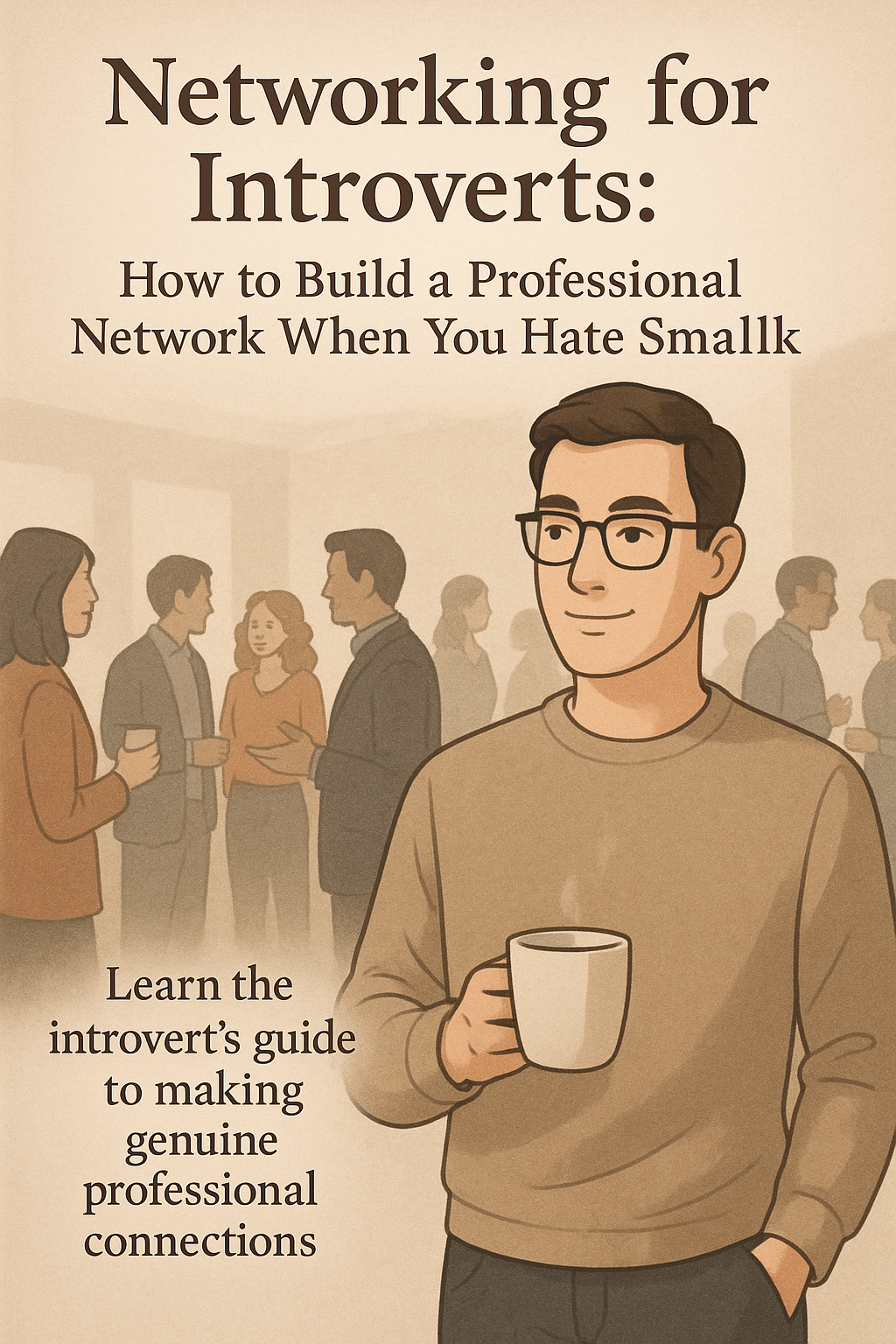
Networking for Introverts: How to Build a Professional Network When You Hate Small Talk
The word "Networking" usually triggers a specific image: A loud, crowded conference room where people in suits are aggressively handing out business cards, drinking lukewarm coffee, and making fake small talk about the weather.
For an introvert, this is not an opportunity; it is a nightmare.
If you are an introvert, you probably believe that you are "bad" at networking. You see the extroverts—the ones who can talk to a brick wall and charm a stranger in 5 minutes—and assume they have the advantage.
But here is the secret: Introverts are actually better at networking than extroverts.
Extroverts are good at meeting people. Introverts are good at connecting with people. Real networking is not about collecting 500 business cards; it is about building 5 genuine relationships that will support your career for a decade. Introverts, with their listening skills and preference for depth over breadth, are naturally built for this.
You don't need to change your personality to build a world-class network. You just need to change your strategy. Here is the introvert’s playbook for building connections without the anxiety.
Strategy 1: The "One-on-One" Advantage
Introverts drain their battery in groups but often thrive in deep, one-on-one conversations. Stop forcing yourself to go to "Mixers" and "Happy Hours." They are inefficient.
- The Shift: Focus on Informational Interviews.
- The Method: Instead of wandering a room hoping to bump into someone, reach out to one specific person on LinkedIn whose career you admire.
- The Ask: "I’m not looking for a job right now, but I’d love to buy you a coffee (or have a 15-min virtual chat) to ask about your perspective on [Industry Trend]."
- Why it works: You control the environment. It is quiet, focused, and has a clear purpose. You can prepare your questions in advance, removing the pressure to "improvise."
Strategy 2: The "Service" Mindset
Anxiety often comes from thinking, "What can I get from this person?" You feel like a leech. Flip the script to: "How can I help this person?"
- The Tactic: When you meet someone, listen for their problems.
- Are they hiring? (Send them a candidate).
- Are they looking for a tool? (Recommend software you use).
- Are they visiting your city? (Recommend a restaurant).
- Why it works: When you focus on being helpful, you stop worrying about being "interesting." You become valuable.
Strategy 3: Play the "Reporter" Role
Small talk is painful because it is surface-level. Introverts prefer depth. The fastest way to bypass small talk is to ask questions.
- The Technique: Imagine you are a journalist interviewing them. People love talking about themselves.
- The Scripts:
- Instead of: "Nice weather, huh?"
- Ask: "What’s the most interesting project you’re working on right now?"
- Instead of: "What do you do?"
- Ask: "How did you get started in [Industry]? It seems like such a unique path."
- The Result: They do 80% of the talking. You do 20% (listening). They leave thinking you are a "great conversationalist."
Strategy 4: The Digital Network (Your Safe Space)
You don't have to leave your house to network.
- Comment Diplomacy: Pick 5 leaders in your industry on LinkedIn. Commit to commenting on their posts twice a week.
- Don't say: "Great post!"
- Do say: "Interesting point about X. I’ve noticed that [Add your insight]. Thanks for sharing."
- The "Warm" DM: After a few weeks of commenting, send a connection request. "Hi [Name], I’ve been enjoying your posts on [Topic] and wanted to connect."
- Why it works: It builds familiarity slowly, on your own time, without the pressure of face-to-face interaction.
Strategy 5: The "Wingman" Strategy
If you must attend a conference or event, bring an extroverted friend.
- The Setup: Your extroverted friend breaks the ice and introduces you. You then step in for the deeper conversation once the connection is made.
- The Exit Strategy: Give yourself permission to leave early. You don't need to stay for the 3-hour after-party. Set a goal: "I will talk to 3 people, and then I will go home and watch Netflix."
Strategy 6: The Follow-Up (Where the Magic Happens)
Extroverts are great at the initial meeting but often terrible at the follow-up. This is where introverts win.
- The Note: Send a message 24 hours later.
- "Hi [Name], it was great meeting you yesterday. I really enjoyed our chat about [Specific Topic]. Here is that article I mentioned. Let’s stay in touch."
- The Check-In: Put a reminder in your calendar to check in every 3-6 months. "Hi, just saw this news about your company—congrats!"
Conclusion: Quality Over Quantity
Networking is farming, not hunting. You are planting seeds.
You do not need to be the loudest voice in the room to be the most influential. By leveraging your natural strengths—listening, empathy, and thoughtful communication—you can build a network that is based on trust, not just business cards.
To find the right people to start your one-on-one outreach with, browse the professionals listed on JobPe Companies.
For more guides on navigating the corporate world on your own terms, https://jobpe.com.

Creative Content Writer
More from Debojyoti Roy
How to Explain Employment Gaps on Your Resume (Without Apologizing)
Worried about the 6-month gap on your resume? Don't panic. Learn how to explain career breaks due to layoffs, health, or family care without sounding defensive.
2025-12-22
The Ultimate Salary Negotiation Guide: How to Increase Your Offer
Stop leaving money on the table. Learn the exact scripts to negotiate your salary offer, handle the "what is your expected salary" trap, and get paid what you are worth.
2025-12-22
How to Quit Your Job Without Burning Bridges (Resignation Letter Templates)
Planning to resign? Don't rage-quit. Learn how to resign professionally, handle the notice period, and write a resignation letter that keeps your reputation intact.
2025-12-22
How to Pass the HR Phone Screen: The 15-Minute Gatekeeper Interview
The HR phone screen is the first hurdle in the hiring process. Learn what recruiters are looking for, how to answer the salary question early, and how to guarantee you move to the next round.
2025-12-19
How to Follow Up After an Interview (Without Being Annoying)
The interview went great, but now... silence. Learn the art of the post-interview follow-up. Get exact email templates for thank-you notes, status checks, and what to do if you get ghosted.
2025-12-19