


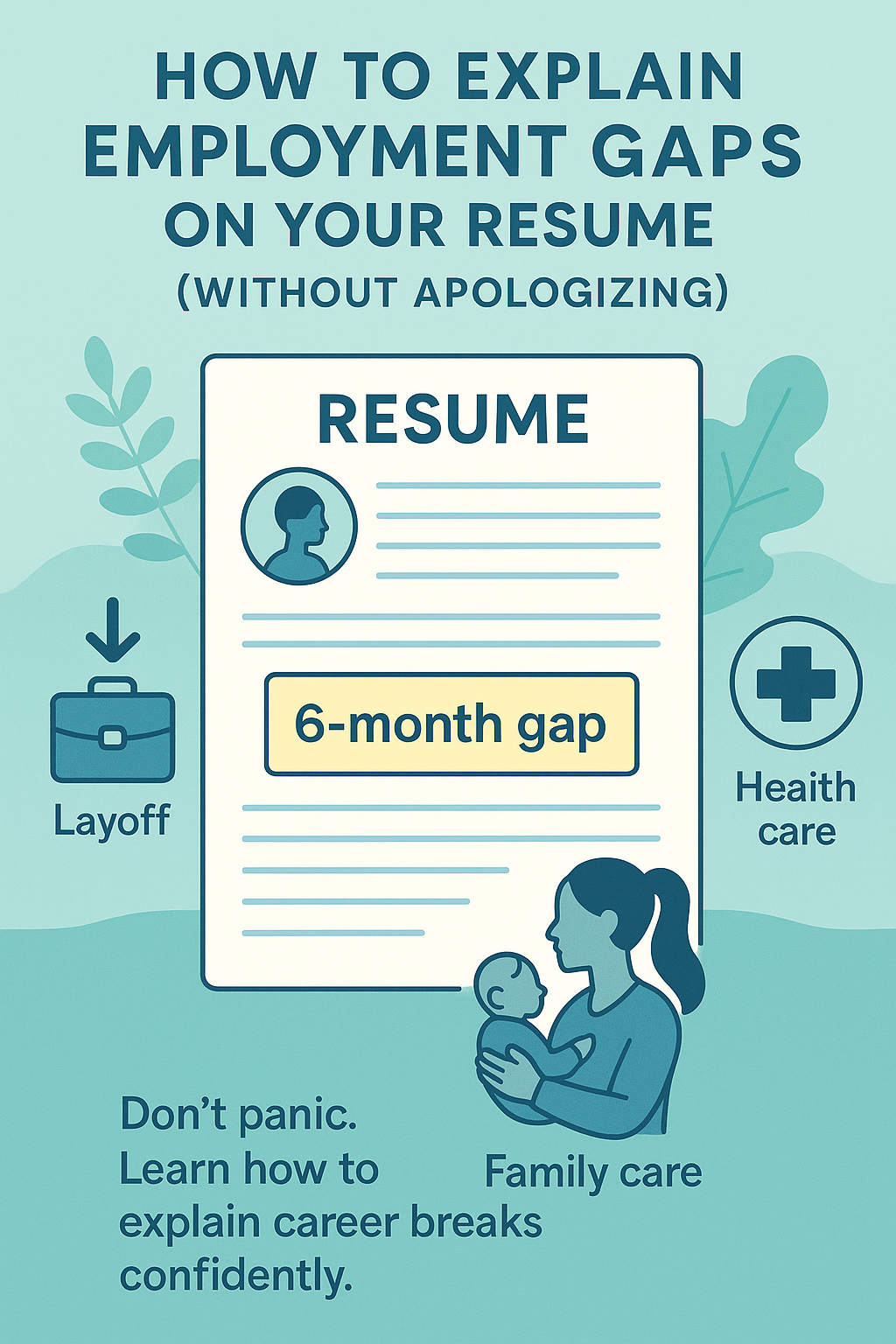
How to Explain Employment Gaps on Your Resume (Without Apologizing)
There is a 6-month hole in your resume.
Maybe you were laid off. Maybe you took time off to care for a sick parent. Maybe you just traveled the world to find yourself. Or maybe, you were just looking for a job and it took longer than expected.
In the old corporate world, an employment gap was a "red flag." It signaled laziness or unreliability.
In 2026, the stigma is fading.
After the global events of the last few years (pandemics, mass tech layoffs), hiring managers now understand that careers are rarely linear lines. Gaps happen. Life happens.
The problem isn't the gap itself; the problem is how you explain it.
If you try to hide it, lie about it, or apologize profusely for it, you look guilty. If you own it with confidence and frame it as a period of growth, it becomes a non-issue.
This guide will teach you the art of the "Gap Narrative"—how to structure it on your resume and exactly what to say in the interview.
Part 1: How to Handle Gaps on Your Resume
Do not leave a mysterious blank space. Applicant Tracking Systems (ATS) and recruiters hate mystery. If you leave it blank, they assume the worst (you were fired for cause, or you were in jail).
Control the narrative by listing the gap.
Option A: The "Years Only" Format
If the gap is small (less than a year), you can switch your resume dates from "Month/Year" to just "Year." * Before: * Job A: Jan 2022 – March 2024 * Job B: Nov 2024 – Present * (Gap: 8 months) * After: * Job A: 2022 – 2024 * Job B: 2024 – Present * (Gap: Invisible)
Option B: The "Active Break" Listing
If the gap is longer (1+ years), list it like a job entry. Give it a title.
Career Sabbatical & Professional Development | 2023 – 2024 * Completed Google Data Analytics Certification. * Traveled to 4 countries, enhancing cross-cultural communication skills. * Managed family estate and healthcare logistics for an elderly relative.
Part 2: The Interview Scripts (By Scenario)
When the interviewer asks, "I see there is a gap here between 2023 and 2024. What were you doing then?" use these scripts.
Scenario 1: The Layoff (It Wasn't Your Fault)
Keep it brief. Do not badmouth the old company. * The Script: "Unfortunately, my role was impacted by a company-wide restructuring/layoff that affected 20% of the workforce. I’m proud of the work I did there, specifically [Project X], and since then, I’ve been taking the time to find a role that aligns perfectly with my skills in [Skill Y], rather than rushing into the wrong fit."
Scenario 2: Family Care / Health (The Personal Reason)
You do not owe them your medical history. Keep it high-level. * The Script: "I took some planned time off to care for a family member / manage a personal health matter. That issue is now fully resolved, and I’m ready to return to work full-time with renewed energy." * Why it works: The phrase "fully resolved" is key. It reassures them you won't quit again in 3 months.
Scenario 3: The "Job Hunt Took Too Long" (The Honest Approach)
Sometimes the market is just bad. * The Script: "After leaving my last role, I decided to be very intentional about my next step. I spent the last 6 months upskilling in [New Tool] and freelancing for a few clients to stay sharp. I turned down a few offers that didn't feel right because I wanted to ensure my next move was a long-term commitment, like this role."
Scenario 4: The Sabbatical / Travel (The Growth Story)
Don't say "I went to the beach." Say "I gained perspective." * The Script: "I had worked non-stop for 6 years and decided to take a planned sabbatical to recharge and travel. It was an incredible experience that taught me adaptability and budgeting. I’m now refreshed and eager to dive back into a structured corporate environment."
Part 3: Turning the Gap into a Feature
The best defense is a good offense. If you did anything productive during your gap, highlight it.
- Did you freelance? You weren't "unemployed"; you were a "Consultant."
- Did you take a course? You were a "Full-time Student."
- Did you try to launch a startup and fail? You gained "Entrepreneurial Experience."
Resume Example:
Freelance Marketing Consultant | Jan 2024 – Present * Provided content strategy services for 3 small businesses during career transition. * Maintained proficiency in SEO tools and Google Analytics.
What NOT to Do
- Don't Overshare: Do not say, "I was so depressed after my breakup that I couldn't work." Keep it professional.
- Don't Lie: Do not extend the dates of your old job to cover the gap. Background checks will catch this, and they will rescind the offer.
- Don't Apologize: You didn't do anything wrong. Taking a break is not a crime. Speak about it with the same confidence you speak about your work history.
Conclusion: Focus on the "Now"
Recruiters care less about what you did 6 months ago and more about what you can do today.
Once you explain the gap concisely (in under 30 seconds), pivot the conversation back to the future: "And that brings us to today. I’m really excited about this position because..."
To make sure your gap looks professional on paper, use the pre-formatted templates in the JobPe Resume Builder.
For more advice on navigating tricky career situations, https://jobpe.com.

Creative Content Writer
More from Debojyoti Roy
The Ultimate Salary Negotiation Guide: How to Increase Your Offer
Stop leaving money on the table. Learn the exact scripts to negotiate your salary offer, handle the "what is your expected salary" trap, and get paid what you are worth.
2025-12-22
How to Quit Your Job Without Burning Bridges (Resignation Letter Templates)
Planning to resign? Don't rage-quit. Learn how to resign professionally, handle the notice period, and write a resignation letter that keeps your reputation intact.
2025-12-22
How to Pass the HR Phone Screen: The 15-Minute Gatekeeper Interview
The HR phone screen is the first hurdle in the hiring process. Learn what recruiters are looking for, how to answer the salary question early, and how to guarantee you move to the next round.
2025-12-19
How to Follow Up After an Interview (Without Being Annoying)
The interview went great, but now... silence. Learn the art of the post-interview follow-up. Get exact email templates for thank-you notes, status checks, and what to do if you get ghosted.
2025-12-19
Networking for Introverts: How to Build a Professional Network When You Hate Small Talk
Hate networking events? You don't need to be the loudest person in the room to build a powerful network. Learn the introvert's guide to making genuine professional connections.
2025-12-19