


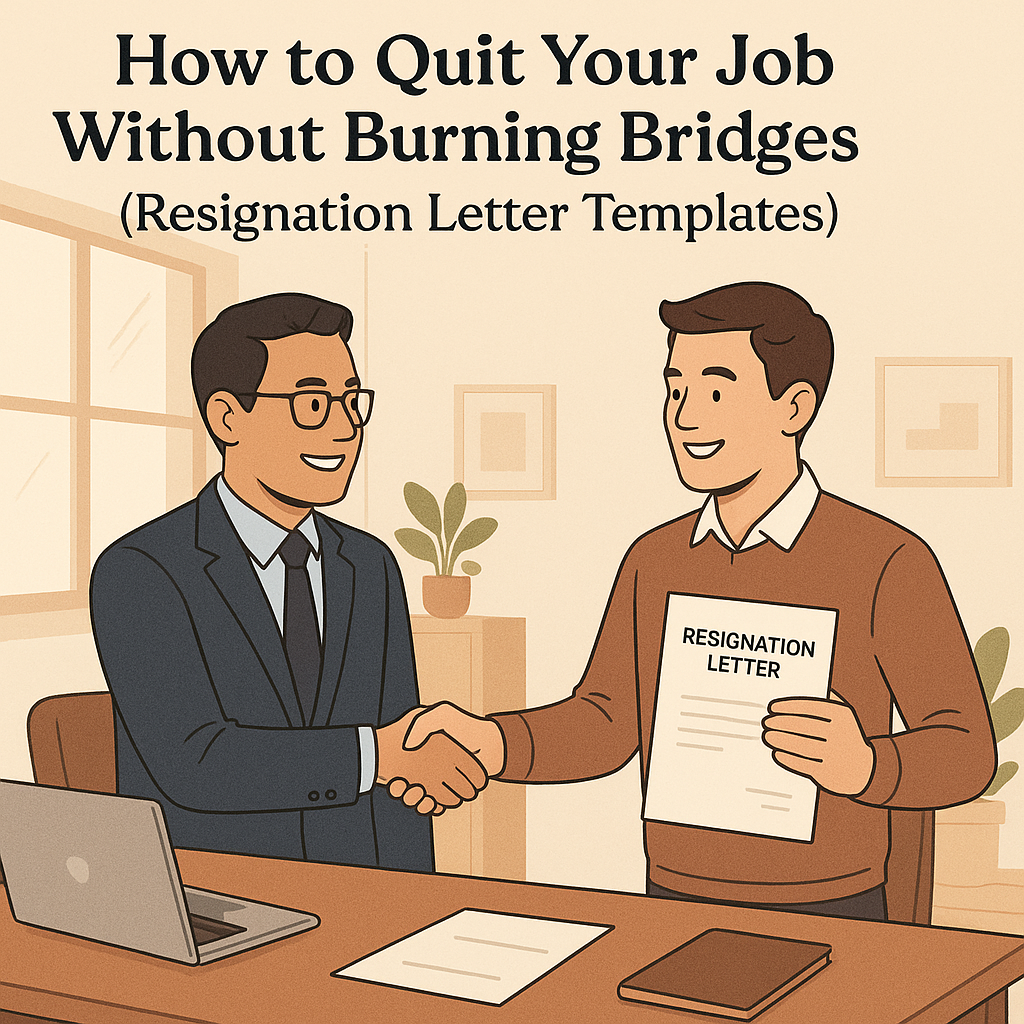
How to Quit Your Job Without Burning Bridges (Resignation Letter Templates Included)
You have signed the offer letter with your new company. The background check is clear. The excitement is building. Now comes the hard part: You have to break up with your current employer.
For many, the fantasy of quitting involves a dramatic speech, flipping a table, and walking out the door like a movie character.
Do not do this.
The professional world is shockingly small. The boss you scream at today could be the client you need to pitch to in five years. The colleague you leave in the lurch could be the hiring manager at your dream company next decade.
Your reputation is built over years but can be destroyed in the final two weeks of your employment.
Leaving a job ("offboarding") requires just as much strategy as getting one. This guide covers the protocol for resigning with class, serving your notice period, and ensuring your legacy remains positive.
Step 1: Tell Your Boss First (The "No Surprises" Rule)
Never let your boss find out you are quitting through a rumor, a tweet, or an updated LinkedIn status.
- The Protocol: Request a quick 1:1 meeting (video or in-person).
- The Script: Keep it short and neutral. > "I requested this meeting to let you know that I’ve decided to move on to a new opportunity. My last day will be [Date]. I want to thank you for the support you’ve given me over the last [Time Period]. I’m committed to making this transition as smooth as possible during my notice period."
- The Counter-Offer: Be prepared. If they offer you more money to stay, know your answer beforehand. (Statistically, 80% of people who accept counter-offers leave within 6 months anyway).
Step 2: The Resignation Letter (Keep It Legal and Brief)
Your resignation letter is a legal document for HR. It is not a diary entry. It is not the place to list your grievances, complain about the coffee, or critique the strategy.
What to include: 1. The statement that you are resigning. 2. Your last day of work (based on your contract). 3. A generic "Thank You."
Template 1: The Standard Professional Resignation
Use this for 99% of situations.
Subject: Resignation - [Your Name]
Dear [Manager's Name],
Please accept this email as formal notification that I am resigning from my position as [Job Title] at [Company Name]. Per my employment contract, I am providing [Number] weeks' notice, and my final day of employment will be [Date].
I want to thank you for the opportunities I’ve had during my time here. I have learned a lot from the team and wish the company nothing but success in the future.
I will do everything I can to ensure a smooth handover of my responsibilities before I leave.
Best regards, [Your Name]
Template 2: The "Short Notice" Resignation
Use this if you need to leave earlier than your contract states (e.g., family emergency or immediate joining required). Note: They can legally refuse this.
Subject: Resignation - [Your Name]
Dear [Manager's Name],
Please accept my resignation from the post of [Job Title].
While my contract states a notice period of [X] months, I would like to request an early release with my last day being [Date], due to [personal reasons / an unavoidable timeline].
I am happy to help speed up the transition or adjust my leave balance to facilitate this early release. I appreciate your understanding.
Sincerely, [Your Name]
Step 3: The Notice Period (The "Fade Out" Trap)
Once you resign, it is tempting to check out mentally. This is called "Senioritis." However, your colleagues will remember how you left. Did you leave a mess for them to clean up? Or did you set them up for success?
The Handover Checklist: * Organize Your Files: Don't leave a desktop full of "Untitled_1.docx." Create a folder called "Handover" with all critical assets. * Write a "How-To" Doc: Write a simple guide for your replacement. "Here is how to run the Tuesday report. Here are the contact details for Client X." * Finish Strong: Work your full hours until the last day. It leaves a lasting impression of integrity.
Step 4: The Exit Interview (The Trap of Honesty)
HR will often ask for an "Exit Interview" to ask why you are leaving. Warning: This is not a therapy session.
- The Myth: "If I tell them the truth about the toxic culture, they will fix it."
- The Reality: They probably won't fix it, but they will label you as "disgruntled" in your file.
- The Strategy: Be polite and vague.
- Instead of: "My boss is an incompetent micromanager."
- Say: "I felt I was ready for a role with more autonomy, which this new opportunity provides."
- Exception: If there was illegal activity (harassment, fraud), report it. For general annoyance, keep it to yourself.
Step 5: The Goodbye Email
On your last day, send a farewell note to your team (BCC is usually best for large groups). Include your personal email or LinkedIn URL so people can find you.
"Hi Team,
Today is my last day at [Company]. I’ve truly enjoyed working with all of you and am proud of what we accomplished.
I’m moving on to a new adventure, but I’d love to stay in touch. You can find me on LinkedIn [Link] or reach me at [Email].
Cheers, [Your Name]"
Conclusion: Leave the Door Open
The goal of resignation is not to escape; it is to graduate. By handling your exit with maturity and grace, you turn former bosses into future references and former colleagues into a lifelong network.
Finish the chapter well so you can start the next one with a clean slate.
Once you are free, make sure your profile is ready for your new start. Update your resume using the JobPe Resume Builder.
For more career lifecycle advice, https://jobpe.com.

Creative Content Writer
More from Debojyoti Roy
How to Explain Employment Gaps on Your Resume (Without Apologizing)
Worried about the 6-month gap on your resume? Don't panic. Learn how to explain career breaks due to layoffs, health, or family care without sounding defensive.
2025-12-22
The Ultimate Salary Negotiation Guide: How to Increase Your Offer
Stop leaving money on the table. Learn the exact scripts to negotiate your salary offer, handle the "what is your expected salary" trap, and get paid what you are worth.
2025-12-22
How to Pass the HR Phone Screen: The 15-Minute Gatekeeper Interview
The HR phone screen is the first hurdle in the hiring process. Learn what recruiters are looking for, how to answer the salary question early, and how to guarantee you move to the next round.
2025-12-19
How to Follow Up After an Interview (Without Being Annoying)
The interview went great, but now... silence. Learn the art of the post-interview follow-up. Get exact email templates for thank-you notes, status checks, and what to do if you get ghosted.
2025-12-19

Networking for Introverts: How to Build a Professional Network When You Hate Small Talk
Hate networking events? You don't need to be the loudest person in the room to build a powerful network. Learn the introvert's guide to making genuine professional connections.
2025-12-19