



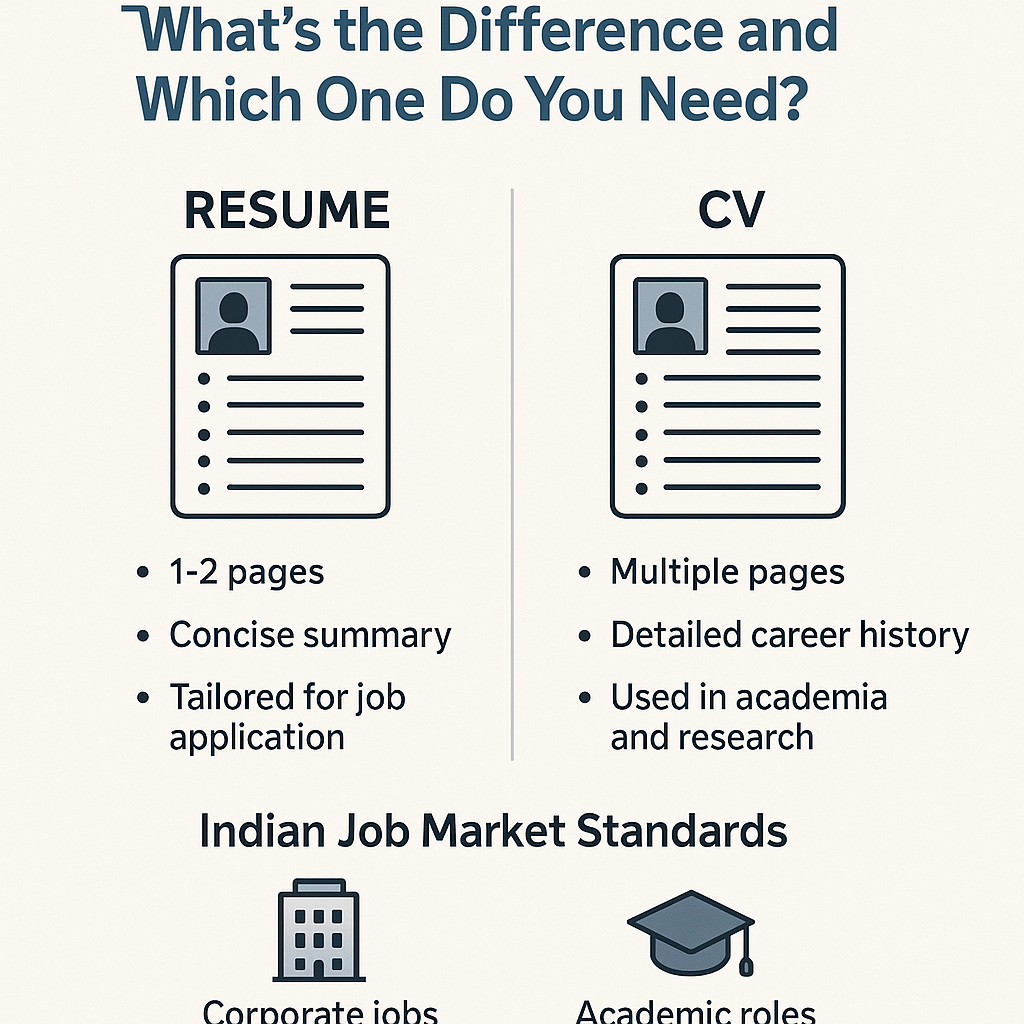
Resume vs. CV What's the Difference and Which One Do You Need?
In the world of job applications, two terms are often used so interchangeably that they've become a major source of confusion: Resume and CV. You'll see one job posting asking for a resume, while another for a similar role requests a CV. This often leaves candidates, especially freshers, in a state of uncertainty. Is there even a difference? Are you supposed to have two separate documents? Are you applying with the wrong one?
In many parts of the world, including India, the terms "resume" and "CV" are frequently used to mean the exact same thing: a one-to-two-page document summarizing your skills, experience, and education for a job application. However, in a formal, international, or academic context, a CV and a resume are two very distinct documents, each with a specific purpose and format.
Using the wrong document in the wrong context can, at best, be confusing for a recruiter and, at worst, make you look unprofessional. Understanding the fundamental differences between these two documents is a critical piece of job search literacy. It ensures you are presenting yourself in the most professional and appropriate light for every opportunity, whether it's a corporate job in India, a faculty position at a university, or a role with a multinational company abroad.
This guide will provide a clear and definitive breakdown of the "Resume vs. CV" debate. We will explore the key differences, explain the specific use case for each, and provide clear guidance on which one you should be using in the Indian job market.
What is a Resume? The Marketing Document
The word "resume" comes from the French word résumé, meaning "a summary." This is the key concept to remember.
A resume is a concise, one-to-two-page document that provides a summary of your skills, experience, and accomplishments. Its purpose is not to be a comprehensive history of your entire career, but to be a highly tailored marketing document designed to get you an interview for one specific job.
Key Characteristics of a Resume:
- Length: It is brief, almost always limited to one page for freshers and professionals with less than 10 years of experience, and a maximum of two pages for senior-level professionals.
- Content: It is highly selective. You only include the experience and skills that are directly relevant to the specific job you are applying for. Your work experience is typically described in achievement-oriented bullet points, not long paragraphs.
- Purpose: The goal is to quickly impress a recruiter and show them, in as little as 10-15 seconds, that you are a strong fit for their open role.
- Customization: A resume must be tailored for every single job application. You should be swapping keywords, highlighting different projects, and rephrasing your summary to align perfectly with the job description. A tool like the JobPe Resume Builder is ideal for creating these customized, impactful resumes.
What is a CV (Curriculum Vitae)? The Historical Document
The term "CV" is short for the Latin phrase Curriculum Vitae, which translates to "the course of one's life." This is also a key concept to remember.
A CV is a long-form, comprehensive, and static document that details the entire course of your academic and professional life. It includes every single publication, presentation, research project, degree, and honor you have ever received.
Key Characteristics of a CV:
- Length: There is no page limit. A CV for an experienced academic or researcher can easily run from 10 to 30 pages or more.
- Content: It is static and all-encompassing. You do not change a CV for different applications. You simply add to it as you accomplish more. It includes sections like:
- Detailed Education and Academic History
- Research Experience
- List of Publications
- List of Conference Presentations
- Teaching Experience
- Grants, Fellowships, and Awards
- Professional Licenses and Certifications
- Memberships in Professional Associations
- Purpose: The goal of a CV is to present your full credentials and expertise within the academic, medical, or scientific community. It is a complete historical record of your contributions to your field.
The Big Question: Which One Should You Use in India?
Here is the simple answer for 99% of job seekers in India: You need a RESUME.
In the Indian corporate and private sector job market, the words "CV" and "resume" are used interchangeably to mean a resume. When a job description in India asks for your "CV," they are almost certainly asking for a concise, one-to-two-page summary of your relevant skills and experience. They are not asking for a 15-page academic document.
This is a critical distinction. Sending a 10-page academic-style CV for a corporate software developer or marketing manager role would be a major mistake. The recruiter does not have time to read it and will likely see you as out of touch with professional norms.
The Only Exceptions (When You Actually Need a CV):
You will only need a true, multi-page Curriculum Vitae (CV) in India if you are applying for: * Academic Positions: Roles as a professor, lecturer, or researcher at a university or research institute. * Scientific Research Roles: Positions in R&D facilities or scientific organizations (e.g., ISRO, CSIR labs). * Medical Positions: Some high-level roles for doctors and medical researchers may require a detailed CV listing all their publications and clinical trials.
For everyone else—engineers, managers, marketers, analysts, freshers, and all other professionals in the private sector—you are building a resume.
What About International Jobs?
This is where the distinction becomes crucial again. * In the United States and Canada: The term "resume" is used exclusively for corporate jobs. A "CV" is used only for academic, medical, and scientific roles, just like in India. * In the United Kingdom, Europe, Australia, and New Zealand: The term "CV" is the standard term for all job applications. However, the format they expect is often a hybrid, typically a two-to-three-page resume that is slightly more detailed than a one-page US resume but not a full-length academic CV.
Your safest strategy: When applying internationally, always research the local standard for that specific country.
Conclusion Your Focus Should Be on a Powerful, Tailored Resume
For the vast majority of job seekers in India, the "resume vs. CV" debate is a simple one. You need to focus all your energy on creating a single, powerful, and masterfully crafted resume. This document should be: * Concise: One page is ideal, two pages is the maximum. * Tailored: Customized with keywords for every job you apply for. * Achievement-Oriented: Focused on your results, not just your responsibilities.
Stop worrying about the terminology. Whether a job posting asks for a "resume" or a "CV," what they want is a powerful marketing document that proves you are the best candidate for the role.
To ensure your resume is ready for the modern job market, it's critical to make sure it's optimized for the Applicant Tracking Systems (ATS) that all major companies use. Running your document through a free ATS Check can give you instant feedback on its compatibility. Once your resume is polished, you can prepare to talk about it by practicing common interview questions. To find the right roles to apply to, you can set up targeted job alerts.
For more tools and resources to help you build the perfect job application, https://jobpe.com.

Creative Content Writer
More from Debojyoti Roy
Stop Listing Duties! How to Write Resume Bullet Points That Get You Hired
Is your resume a boring list of "Responsible for..."? Recruiters hate that. Learn the "Google XYZ Formula" to transform your bullet points from passive duties into data-backed achievements.
2026-02-12
ATS Myths Debunked: Why Your Resume Is Being Rejected (It’s Not a Robot)
Stop blaming the "resume robot." Learn the truth about Applicant Tracking Systems (ATS), why "white font hacking" fails, and how to format your CV to actually get read by a human.
2026-02-12
How to Get a Job You Are "Underqualified" For (Without Lying)
Don't meet 100% of the job requirements? Apply anyway. Learn the "60% Rule," how to translate your skills, and the exact script to prove you are the right hire despite the experience gap.
2026-02-12
LinkedIn SEO: 5 Profile Tweaks to Get Headhunted on Autopilot
Learn the 5 specific keywords and profile tweaks to rank #1 in recruiter searches and get job offers while you sleep.
2026-02-11
Burnout Recovery Guide: How to Reset Your Brain Without Quitting Your Job
Learn the 3 stages of burnout, why a vacation won't fix it, and the "Micro-Habits" to reset your cortisol and fall in love with your work again.
2026-02-11