



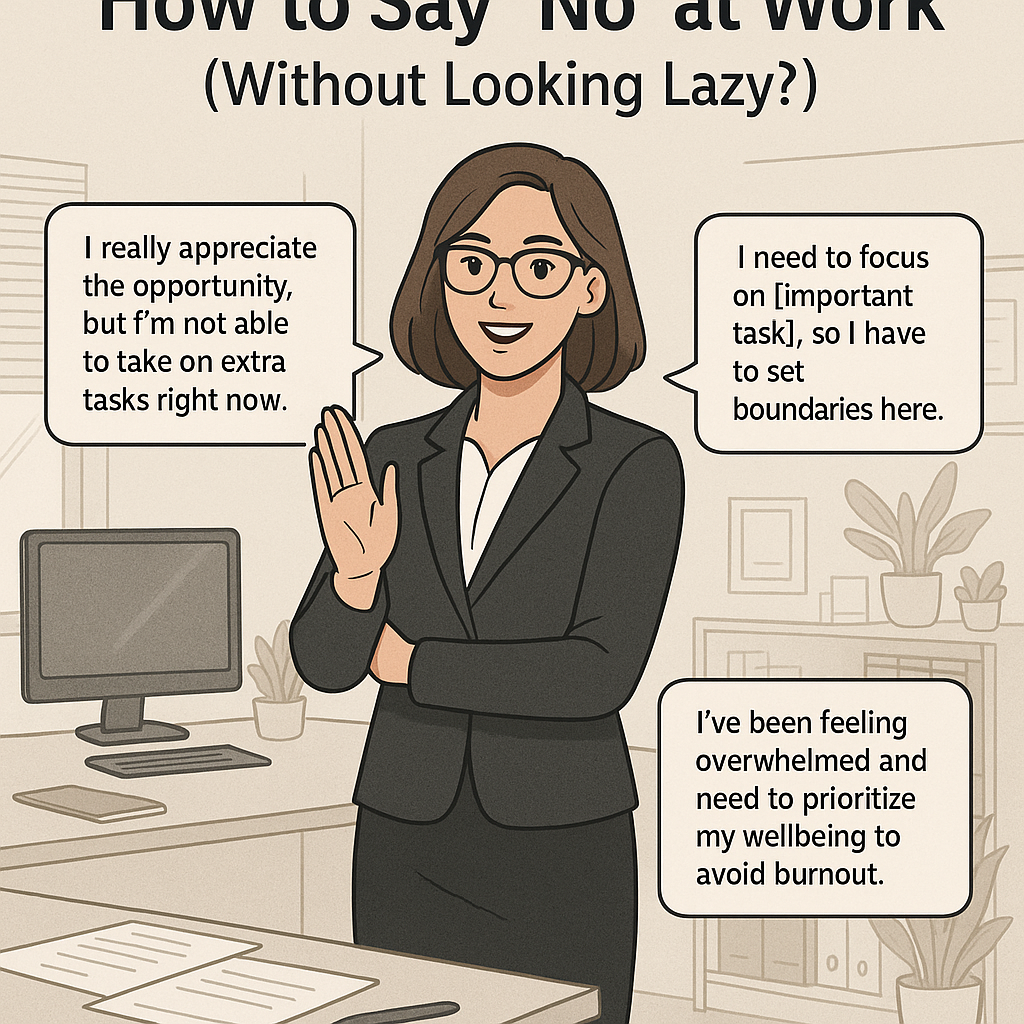
How to Say "No" at Work (Without Looking Lazy)
The easiest word to say in an office is "Yes."
- "Can you take on this extra project?" "Yes."
- "Can you join this committee?" "Yes."
- "Can you finish this by tomorrow?" "Yes."
We say "Yes" because we want to be helpful. We say it because we are afraid that saying "No" makes us look lazy, uncommitted, or "not a team player."
But here is the trap: If you say Yes to everything, you end up doing nothing well.
You become the "Dumpster" for low-value work. Your quality suffers. Your burnout spikes. And ironically, the people who say "No" get promoted because they focused on the high-impact work that actually matters.
You don't need to be rude to say "No." You just need to be strategic.
Here are the 3 scripts to decline work while sounding like a committed, responsible professional.
Strategy 1: The "Capacity" No (For When You Are Full)
The Trap: Saying "I'm too busy." * Why it fails: "Busy" is subjective. Your boss might think, "Well, just work faster."
The Fix: Make your workload visible. Treat your time like a budget. If the budget is spent, you can't spend more.
The Script:
"Thanks for thinking of me for this. I would love to help, but right now my capacity is fully committed to [Project A] and [Project B] to ensure we hit the Friday deadline.
I wouldn't be able to give this new task the attention it deserves without putting those other deadlines at risk.
Alternative: Can we look at this next week after the launch?"
Why it works: You aren't rejecting the work; you are protecting the quality of your current work. That is responsible, not lazy.
Strategy 2: The "Trade-Off" No (For The Boss)
The Trap: Your boss dumps a new urgent task on you. * Why it fails: If you just take it, you will fail at something else, and then get blamed for both.
The Fix: Force them to choose. Put the prioritization burden back on the manager.
The Script:
"I can definitely take this on.
However, right now I am prioritizing [Project X] as we discussed on Monday. If I shift focus to this new task, [Project X] will likely be delayed until Thursday.
Decision: Which one would you prefer I prioritize right now?"
Why it works: You are saying "Yes, but..." This forces the boss to realize that your time is finite. They have to tell you what to drop.
Strategy 3: The "Not Me, But..." No (For Colleagues)
The Trap: A coworker asks for "help" (which usually means "do my job"). * Why it fails: If you do it once, they will ask forever.
The Fix: Offer a resource, not your hands.
The Script:
"I can't jump in on this right now as I'm heads-down on a deadline.
Alternative: However, I have a template/checklist that I used for a similar project last month. I’ll send that over to you—it should speed things up significantly."
Why it works: You are still being "helpful" (sending the template), but you aren't doing the work.
The "Don't" List (How NOT to Say No)
- Don't Over-Explain: "I can't because my cat is sick and I'm tired and..." Stop. The more excuses you give, the weaker you sound. Stick to business reasons (capacity/priorities).
- Don't Apologize Profusely: "I'm so so sorry!" You have nothing to apologize for. You are managing your workload.
- Don't Ghost: Ignoring the email request is not a "No." It is unprofessional. Always reply, even if it is brief.
Conclusion: "No" protects your "Yes"
Warren Buffett said, "The difference between successful people and really successful people is that really successful people say no to almost everything."
Every time you say "No" to a low-value task, you are saying "Yes" to your mental health and your high-value projects.
Start small. Practice on a low-stakes request today. Reclaim your calendar.
To analyze where your time is actually going so you can make a data-backed case to your boss, try the JobPe Time Audit Tool.
For more productivity and mental health tips, https://jobpe.com.

Creative Content Writer
More from Debojyoti Roy
Stop Listing Duties! How to Write Resume Bullet Points That Get You Hired
Is your resume a boring list of "Responsible for..."? Recruiters hate that. Learn the "Google XYZ Formula" to transform your bullet points from passive duties into data-backed achievements.
2026-02-12
ATS Myths Debunked: Why Your Resume Is Being Rejected (It’s Not a Robot)
Stop blaming the "resume robot." Learn the truth about Applicant Tracking Systems (ATS), why "white font hacking" fails, and how to format your CV to actually get read by a human.
2026-02-12
How to Get a Job You Are "Underqualified" For (Without Lying)
Don't meet 100% of the job requirements? Apply anyway. Learn the "60% Rule," how to translate your skills, and the exact script to prove you are the right hire despite the experience gap.
2026-02-12
LinkedIn SEO: 5 Profile Tweaks to Get Headhunted on Autopilot
Learn the 5 specific keywords and profile tweaks to rank #1 in recruiter searches and get job offers while you sleep.
2026-02-11
Burnout Recovery Guide: How to Reset Your Brain Without Quitting Your Job
Learn the 3 stages of burnout, why a vacation won't fix it, and the "Micro-Habits" to reset your cortisol and fall in love with your work again.
2026-02-11