


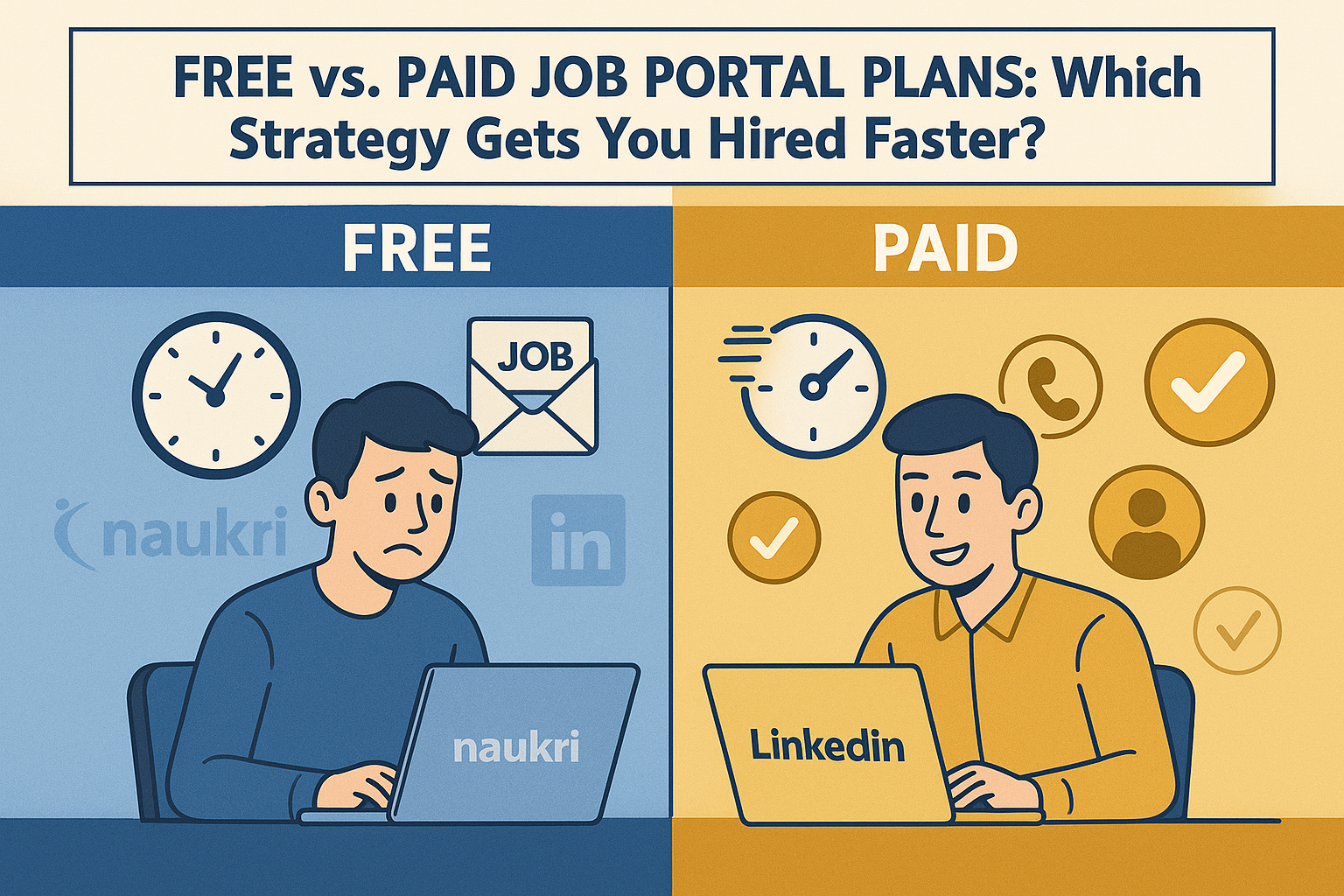
Free vs. Paid Job Portal Plans: Which Strategy Gets You Hired Faster?
In the modern job search, you are constantly bombarded with upsell offers. Every major job board, from LinkedIn to Naukri to Indeed, has a "Premium" or "Gold" version. They dangle enticing promises in front of frustrated job seekers: "See who viewed your profile," "Get to the top of the recruiter's inbox," "Unlock salary insights," or "Get featured status."
When you've been applying for weeks with little success, these paid plans can feel like a lifeline. You start to wonder: "Is this the missing piece? Is the algorithm punishing me for being a free user? If I just pay ₹2,000 a month, will the interview calls finally start rolling in?"
It’s a valid question. Is a paid job portal subscription a smart investment in your career, or is it a "vanity tax" on your desperation? Does throwing money at the platform actually speed up your hiring process?
The answer is not a simple yes or no. Paid plans offer specific tools that can be powerful, but only if you know how to use them. For most job seekers, however, a smart "free" strategy will outperform a passive "paid" strategy every time. This guide will break down the real value of paid features versus free tactics, helping you decide where to invest your limited resources—your time or your money.
The "Free" Strategy: The Baseline for Success
Before you spend a rupee, you need to understand what you can achieve for free. The vast majority of people get hired without ever paying for a premium subscription.
What you get for free: * Access to Jobs: You can see and apply to almost every job posting. * Profile Visibility: Recruiters can still find you if your profile is optimized with the right keywords. * Basic Alerts: You can set up job alerts to be notified of new roles.
The "Free" Power Strategy: Success on a free plan relies on optimization and activity. 1. Keyword Optimization: Since you aren't paying to be "featured," you must earn your visibility organically. This means meticulously optimizing your profile and resume with the exact keywords recruiters are searching for. 2. Speed: You need to be one of the first to apply. Set up aggressive job alerts so you can apply within the first 24 hours of a posting. 3. Networking: You can't send unlimited InMails, so you have to connect genuinely. Send personalized connection requests to hiring managers and peers.
Verdict: The free strategy is highly effective but requires more manual effort and strategic discipline.
The "Paid" Strategy: What Are You Actually Buying?
Let's look at the specific features paid plans offer and evaluate their ROI (Return on Investment).
1. "Featured" Applicant Status (e.g., Naukri FastForward)
- ** The Promise:** Your application is highlighted or pinned to the top of the recruiter's list.
- The Reality: Recruiters are smart. They know which profiles are "sponsored" and which are organically relevant. Being at the top doesn't help if your resume isn't a match. A poorly written "featured" resume is just a highly visible rejection.
- Verdict: Low ROI. A tailored resume beats a featured one.
2. InMail / Direct Messaging (e.g., LinkedIn Premium)
- The Promise: The ability to email anyone, even if you aren't connected.
- The Reality: This is the most valuable paid feature. It allows you to bypass the gatekeepers and message a hiring manager directly. However, it only works if you write a compelling cold email (as discussed in our Cold Email Guide). A generic InMail is a waste of a paid credit.
- Verdict: High ROI (if you are a good writer and target the right people).
3. "Who Viewed Your Profile"
- The Promise: See the full list of people who checked you out.
- The Reality: It satisfies curiosity but rarely leads to a job. Unless you plan to proactively message every recruiter who glanced at your profile (which can seem desperate), this is vanity data.
- Verdict: Low ROI.
4. Competitive Insights (e.g., "You are in the top 10% of applicants")
- The Promise: See how you stack up against other candidates based on skills and education.
- The Reality: This data is often broad and based on self-reported skills. Knowing you have a "Masters Degree" like 40% of other applicants doesn't tell you if you're actually the best fit. It can often just increase your anxiety.
- Verdict: Medium ROI (Good for a reality check, bad for confidence).
When Should You Pay? (The Strategic Use Case)
Paying for a plan makes sense in specific scenarios: * You are in a Rush: If you need a job now, buying LinkedIn Premium for one month to aggressively InMail 50 hiring managers is a valid "sprint" strategy. * You are Pivoting Careers: If your resume doesn't naturally match the keywords for your new field, using InMail to explain your story directly to a human can bridge the gap that an ATS would block. * You are Senior Executive: At the executive level, the pool is smaller, and direct networking via InMail is the standard mode of communication.
The Winning Hybrid Approach
The best strategy isn't "Free vs. Paid." It's "Optimized Free + Strategic Paid Sprints."
- Build on Free: Spend your time perfecting your resume with the JobPe Resume Builder and optimizing your LinkedIn profile for keywords. This is your foundation.
- Use the Free Trial: Almost every platform offers a 1-month free trial of their premium service. Save this for when you are ready. Don't use it in week 1. Use it in week 4, when your materials are perfect and you have a list of 30 target companies.
- Execute a 30-Day Sprint: Activate the trial. Use the InMails. Use the competitive insights to tweak your resume. Go all out for 30 days.
- Cancel and Evaluate: If you haven't seen results, the problem is likely your profile or your outreach message, not the lack of a "Gold" badge. Go back to the free plan and refine your strategy.
Conclusion: Strategy Beats Subscription
A paid subscription is a tool, not a magic wand. It cannot fix a weak resume, a poor portfolio, or a lack of interview preparation.
Before you swipe your credit card, ask yourself: "Have I done everything possible to optimize my free search?" If the answer is no, fix your resume first. If the answer is yes, then a strategic, short-term investment in premium features might be the boost you need to close the deal.
To find the best opportunities to use your strategy on, whether free or paid, keep your job alerts highly targeted and active.
For more tools to help you maximize your job search ROI, https://jobpe.com.